Showing posts with label spoken. Show all posts

Wednesday, October 27, 2010

Whooping Poetry


Recently there has been some intense discussion in certain circles about the increase in Black American churches of “whooping,” the vocal technique whereby a preacher urges for an emotional response to his sermon, and its value not only as a part of communal worship but also as a means to deliver the message. Those of a rational mind-set prefer their sermon to be delivered as lecture, reasoned point by point to a determined conclusion. Others see bringing and receiving the message as involving more than the mind, and that whatever will emphasize it is valid even if not necessary.

Whooping, as practiced by black preachers, is a rhetorical device. Most agree it should not be used to present the substance of the sermon, the message. However, some of those who practice it refer to it as the “gravy;” after delivering the meat-and-potatoes you pour on the extra, the joyful element. Others see it as a method of emphasizing, impressing in the spirit what has been given to the mind and thereby involving the whole person – often with physical responses, whether by voice or body or both.

Now what has this to do with poetry? Let me explain. I believe that poetry is as much a vocal art as singing. Before general literacy, well into the twentieth century, people experienced poetry as spoken language. I see the book, the page, as a storage and retrieval system. Even when I read silently to myself, I want to fear the words sing in my own voice. And, when poetry is publicly presented on a stage, any technique of drama or rhetoric that enhances the poem is important.

On more than one occasion my delivery, my method of presentation, has been compared to that of a preacher. And that's not a bad thing. In poetry I want to involve much more than reason. I want to invoke an emotional response, even a spiritual one if you will. The greater the audience involvement is, the more the poem is poetry.

I admire the cadence structures used by black preachers to enhance their sermons. I may take a look at my own delivery of certain poems to see if such a (deliberate) stucture can work for them.


Monday, April 19, 2010

The Fire, The Fire!

A few days ago I picked up second hand an anthology of contemporary African-American poetry published toward the end of the twentieth century titled Catch the Fire!!! It’s interesting and important because it identifies current rap and hip-hop artists as part of the stream of black writers/poets/artists of the U. S.

The book is divided into six segments; each is introduced by a black cultural figure of importance with reflections and encouragements. The overriding theme of the book urges the young poets to be positive and passionate, to catch and spread the fire actively. The editor and many of the younger poets included are wordsmiths, presenters of ideas in the language of their culture and the immediacy of post literary media – black street talk with rap beats, to be performed as spoken word and disseminated as recordings.

The work in this volume lives up to that challenge. It burns with passion. There are poems from some of the well-known and established poets and writers: Amiri Baraka, Nikki Giovanni, Quincy Troupe, and Sonia Sanchez. These establish the immediacy and the tradition. But much of the collection consists of work by younger poets, often rap and slam artists, who try to burn the fire of their performance onto the black and white of the page.

It all shows that there is a tradition of black poetry - revolutionary perhaps, passionate certainly – that flows through American letters. Much of it is, as mentioned before, available only through performances or recordings. And this is where the more established poets come in with advice and direction. They urge the young to write and then look at their work, not simply to consider performance but the writing as literature. To not only listen to their contemporaries but also to read them, study them, find what works and what doesn’t. To delve into the craft of poetry beyond rhyme and rhythm and into simile and metaphor. To read and use everything you can until you’ve worked out something you feel comfortable with, a voice, and a positive attitude you can share. Use poetry to reach outside yourself so it can become part of everyone else.

And with such advice it is easy to see how rap and hip-hop, filtered though the experience of black people’s existence, is real poetry. It may not have the ancient, European forms and cadences but the power and confidence cannot be denied. The fire that exists on the stage is being transferred to the page. And the page will be all the better for it, will not be consumed.


Sunday, February 21, 2010

In Performance

I went out the other evening to a concert, just to treat myself to something different for my birthday. There was a duo, the Undesirables, who performed mainly narrative songs. (Imagine a novel turned into song, or was that a song based on the novel?) They were enjoyable enough but were only the intro for the main attraction of the evening, C. R. Avery accompanied by the Legal Tender String Quartet. I had never heard of either act but went because the promo mentioned Tom Waits with both of them. C.R. Avery was a truly joyful birthday surprise!


Now those who have nuzzled through this site before know how I love performance art in all its forms – music, theatre, storytelling, and especially poetry. Let me tell you, Avery was a combination of the best of them all. I will try to describe his performance, but my words may be inadequate.

First of all, he is a poet, and has won the Great Canadian Poetry Face-off. He works in the poetic tradition, with rhythm, rhyme, imagery and various devices. He’s also one-third of T. O. F. U., the Tons Of Fun University group out of Vancouver that recently gave us Shane Koyczan, the poet who performed at the Winter Olympics’ opening ceremonies. He brings a beat/hip-hop sensibility to his presentation, both physically and aurally. And then the music.

Aside from the vocals and beat-box scratching and rhythm sounds with his voice, he played marvelous blues harmonica, using each to compliment the others. He was accompanied by a man who played a fine guitar with his hands and rhythm instruments with his feet. His sound was filled out by the Legal Tender String Quartet, a classically trained foursome of cello, viola, and two violins.

And now the problem lies in how to describe it. Let’s drop some performing beat (preferably Ginsberg) in a pot with early Bob Dylan imagery from his talking blues numbers. Add some Springsteen/ Mellencamp and a heap of Bukowski. Leave room for a lot of Patti Smith and enough Tom Waits to color the mixture. Don’t forget to season with Little Walter’s harp. And press it all through the best of hip-hop.

Damn. That still doesn’t do justice. That’s a poor approximation of what I experienced.

Excuse me, I’ve got to put his CD in the player. Why don’t you try it for yourself.


Thursday, December 10, 2009

Sounds of Poetry

Let's be clear from the start. This entry is not about 'sound poetry,' the use of sound as opposed to words as a means of poetic expression. Here we are dealing with the sounds that are language, that form the words we use, and especially of those sounds as they take part in our poetry.

Two incidents brought this to mind recently. First I had taken my cat to the veterinarian for his annual checkup and necessary booster shots. When we got home he was quite put out and avoided me. Some time later I lay down on the bed and invited him to join me. He did, and after some time ended up lying against my chest, purring. In return, I hummed deep in my throat and chest in response. We quietly lay, side by side, exchanging vibrations. It reminded me of how a mother will use a wordless hum to soothe a fussy baby.

Now for the second influence. I was reading a passage of poetry aloud to myself when I noticed that the author had used an unusual number of 'm' and 'n' sounds in one of the four line stanzas, and the soothing effect (much like the cat or a baby) that had on me. I had read the poem before, but never aloud. I was so intrigued that I read the poem again several times, this time emphasizing and lengthening those sounds. Granted, I sounded as if I suffered from an acute stammer, but it certainly heightened the effect.

I thought about how poets when they read their work aloud in public seem to ignore the importance of sound in favour of putting across the meaning of the words. Seldom is there any lingering over a single sound or emphasis on a series of sounds. And sound is so important to poetry. We use its repetitions to enhance our words: rhyme, both at the ends of lines and internally, and with its many elaborations; alliteration, the repetition of initial consonants; assonance, where the vowel sounds repeat but not the consonants; consonance, where the final consonants agree in sound but the vowels do not. And, of course, the many variations of these.

So if a poet goes to all that trouble to use it in the written word, why not note it in the spoken? It doesn't take much. It is not necessary to stop so long that the silence underscores it, or to voice it in such a way as to bring undue attention. The simple answer is to read slower. If we read slower than normal speech (and speech in modern times has tended to quicken noticeably), the hearing ear can catch patterns of sound that could easily pass ignored. Those patterns of sound are as much of the poem as the words and meaning.

So, poets at the mike. Slow down the tumble of words; sing out the sounds.


Saturday, December 5, 2009

Poetry on Stage

Klyde Broox, as promised, returned to the Artword Artbar for his second monthly presentation of poetry on stage. He's still considering what to call it. "Poemagic" was the handle of the series he did at the Staircase; so far he is leaning toward a "soiree."

So, with some speechifying about what he expects and hopes for, he began to present some of his poems in dub style - spoken with appropriate gestures, voicing, posture and movement. Two had built in refrains which called out for audience participation, and participate the audience did: once in two parts, where he divided the room in half and had one side call out the first part of the refrain, followed by the response from the other half, and then all together on the last line. In another poem he divided the chorus into four parts to deliver one word statements (in full voice) and come together for the conclusion.

He invited me up. I presented two of my cat poems with voice and movement enhancements. (When the evening was finished, I watched one member of the audience talking about my performance to someone else; I could tell by the movements and facial expressions. A more honest compliment than common applause or even a thank you afterward.)

After a few more of his own poems, Klyde introduced a man he called "a certified Dub poet, certified by Durm-I" whose name I didn't catch but who had an intriguing story. At Hamilton's first Dub Festival (organized by Klyde) he was moved to explore performance poetry. He wrote one that he performed at a slam in Toronto, was seen by someone who wanted to use it for her show in Poland and perform it there. Her presentation was so well appreciated that he was invited to Poland and did a series of guest performances. His work and intensity held the room at the Artbar spellbound.

Klyde then finished with a few more, and by special request we all joined in on the old favourite, "Yank the Chain."

Although the audience wasn't as great in number this night, it was more than equal in spirit. It may take some time to become as much a part of the community as Poemagic was but it sure feels like it's on its way.


Sunday, November 8, 2009

Mixed Arts

Friday I went to watch my friend Klyde Broox perform at the Artword Artbar. Klyde is an outstanding poet and performer in the Dub tradition. His performance went well. He had provided for musical breaks, a marimba player who accompanied him for several numbers,improvising a rhythm behind him. Klyde also saw fit to introduce a couple of up-and-coming young spoken word artists.
The main point of interest for me, however, was his expressed desire to run a word/performance evening here once a month. He had done this before at the Staircase a few years ago. As he explains, it is an attempt to get the different cultures to work together on the same stage, in the same venue. He envisions black dub poets and white spoken word artists, mixed with musicians and dancers, performers together in a real potpourri. I performed regularly with him at the Staircase and would gladly do so again.
The Artword Artbar, with its already eclectic establishment of entertainments including film, theatre and dance could be the right venue at the right time. The vibes seem positive.

So, let the action begin! Let the colours blend! Let the multitude of cultures come together and present a heady brew!

Wednesday, September 9, 2009

Listening To Silence


I went for a walk one afternoon a week or so ago. That's nothing new; I do that now and then for several reasons. I find it takes me away from the stresses that pile up over time; if I've had more time in the company of a lot of people than I feel comfortable with, a walk is the perfect way to re-focus myself; and surrounded by the natural world, I don't need to be anyone or play any role - just be. So, I took a peaceful stroll through a semi-secluded valley beside a slow-moving stream, kept my mouth shut, and my eyes and ears and mind open.
Somehow along the ramble, a line of thinking developed. I'd been hearing my share of poetry read in the last while, but there seemed to be an integral part missing. Whether the poet who read was dramatic or bland didn't matter. It seemed that all were so intent on getting the words out there, often rattling along like gunfire, that only at the end of a long line (or even several lines) or at the end of a stanza could the poet take a short, sharp breath before continuing. And even that pause was as short as possible so it wouldn't interfere with the delivery of the words, the message.
I believe pauses, stretches of silence, are important to a poem and poetry in general. When I read a printed poem for myself, I am free to pause where I will or must to aid in the comprehension, the digestion of the poem and whatever it delivers. At a public reading or presentation this is often not the case. The better readers, in my opinion, use the weight of silence, of pauses.
Like my quiet afternoon walk, a poem also often needs the emphasis of silence to enhance its full power. We should listen to the silences in a poem as much as to words and meaning. So much of our lives are spent with the awareness of and bombardment by words and sounds that the importance of silence has been lost. We need to re-integrate it into our lives and our poetry.


Sunday, July 19, 2009

Theatre and Poetry

I went to two of the shows running at the current Fringe Festival (theatre) because I had read about several that involved poetry. The first I attended was called "I Hate Poetry."


It had an interesting premise: three spoken word artists (poets) do a last minute impromptu rehearsal for a performance. They act as a troupe and as individuals, and the audience is left to consider what is "act" and what is the characters' unplanned disclosure, what is being rehearsed and what is supposedly not. But about the poetry.

It was the common spoken word genre, at times heavy on rhyme, often rhythm depended on that rhyme, and very little else that establishes language as poetry: the use of metaphor or simile, images to portray meaning that is not immediate. Any emotion or feeling was direct and in your face; all to keep the piece moving. Any contemplation would have to be done elsewhere later.

Still, with all my reservations about spoken word poetry, language, form, and meaning, I found the frantic pacing that is the nature if this type of presentation worked well. It communicated the characters as well as the concerns behind its topic. Thank you, Dream Chasers.


The second performance I went to because it was so highly recomended. "Head First" by the Toronto all-women troupe Femmes du Feu had won a main stream staging at the Toronto Fringe Festival and would only be here for four of the ten days. They had also won an audience choice at the London Fringe and so became a "must-see."

The performance consisted of interpretive dance, most of it aerial. The first segment was a pas-de-deux performed by the two co-founders of the troupe and explored the idea of two people sharing the same dream, not dreaming but existing in the same dream space; it sometimes occupied the floor, sometimes high off the stage, other times in mid-air, often in motion between those levels.
The second part was a mini flamenco performance, an interesting reflection on rhythm and movement. It was all the more intriguing because this was the only part without music; the motion and the tapping of the shoes had to say it all.
The third segment was performed by six dancers, sometimes all together and sometimes in smaller numbers. The movement and accompanying music fluttered and hung in a number of aerial silks, portraying six or seven aspects of a woman's life.
And what has this to do with poetry? There is no better explanation of how expression in poetry should be understood. Rhythm and flow. Brilliance to capture the attention, colour to hold it. The meaning suggested by the movements of the dance, by the phrases of the poetry.
Although meant to be an experience of theatre, the evening became one full of poetry.

Wednesday, May 27, 2009

Listening for Dylan Thomas

In my eclectic reading recently, I came across Dylan Thomas' essay on his poetics titled "Notes on the Art of Poetry." It brought to mind one of the reasons that I am so entranced by poetry, and especially the delivery of it to the audience.

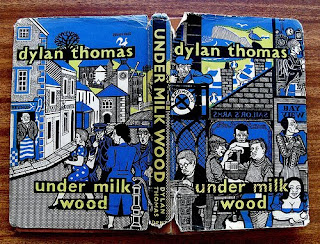
In it Thomas speaks of his fascination with the sound of words, beginning with nursery rhymes as a child. The sound and substance of words came first for him; things like meaning and communication of ideas were secondary. This emphasis on the sound of language permeates most if not all of his poems; it plays a great part in his stories; it is integral to his radio plays. Under Milkwood, his famous play for voices, is probably the greatest example of prose and poetry combined in one work since Shakespeare.

If you're going to make yourself more familiar with Thomas' work, your best approach would be to hear it. Because of his experience working in broadcasting during WWII, he recorded much of his work and much of it is still available.
It is hearing him read, hearing his delivery of the sound and music of the language, that opens the way to an understanding of the meaning of his words and the ideas these words express. "I am a painstaking, conscientious, involved, and devious craftsman in words, however unsuccessful the result so often appears." Words and the way they are used, new expressions shaped from old, all may look odd on the page but resound like church bells in the air around.

Thomas is by no means the only poet who should be heard before he is read. I had but a faint grasp on the poetry of bp nichol before I heard him read it aloud. The dub poets need the voice to convey what the page can not. Any good presenter of his/her own poetry must add something more than can be found displayed in black text on white paper.
Probably because I come from a people who relied on public recitation as a form of community entertainment, on "foardragen," poetry and its presentation aloud mean so much to me. But that's not the only reason. I too love the sound of words; at times I don't care whether or not they mean. In a way it's like opera: who cares what banalities the words may mean, they sound so marvelous!

When I remember Martin Luther King proclaiming, "Let freedom ring!" I hear in my own mind, "Let poetry ring!" Sometimes freedom and poetry are expressions of the same thing.

Let's keep the words and language ringing.


Thursday, December 18, 2008

Poetry In Performance


The poem in performance is not the poem on the page.

I believe that and proclaim it whenever I can; now it's your turn to listen/read.

It's that blog on Beowulf that initiated this one. In the beginning, all poetry was "spoken word" and depended on proclamation/recitation before an audience; there were no written texts; even when writing became available, there were few readers. So, poetry was delivered vocally, by the author or another, as entertainment, as a record of semi-historical events and people, whatever was needed. The custom continued in the Middle Ages when troubadors wandered from place to place, court to court, with songs, ballads and tales. Recital of one's own work or that of others remained a viable method of transmission. Even throughout the nineteenth century this continued.

Printing in itself had not changed that. What did change was the availability of printed material to the masses rather than only the educated inteligentsia, and the increased literacy of the common people. One of the main effects of the twentieth century on poetry was a split between poetry on the page, to be perused and studied carefully, and the poetry presented live before an audience. True, the two overlap often. But the division remains between accademic and populist poetry.

Now to the bit that irritates me so much: I have a difficult time understanding those people who prefer to have a copy of the poem being performed before their eyes, to "follow." The two poems, the one being developed between the speaker and the listener and the other an artifact arranged to sit motionless on a sheet of paper are not the same experience. Very few people can focus on both experiences equally. Both suffer and neither is fully received and understood.

And that is what poetry is about, the sharing of emotions, insights, experience. By imposing unnatural limitations, the poetry is lost. We are left with sounds in the air, words on a page.

I like to read poetry, to taste and feel it in my mind. But for me there is nothing as directly satisfying as to concentrate on the intricate relationships of words and sounds as they ripple between voice and ear.


Walt Whitman sang of himself; Allen Ginsberg howled; Milton Acorn shouted love; Al Purdy was the voice of the land.

They needed to be heard. Now they are no longer with us, they should be read.