Showing posts with label peoples poetry. Show all posts

Friday, March 26, 2010

Worker Poet

The Hamilton Poetry Centre hosted a reading by Tom Wayman. I admire his work, and since I had not heard him read in more than twenty years, I excused myself from my usual Thursday evening activity to attend. He always had the reputation of being the workers’ poet both because of his own poems and several anthologies he compiled on that theme.
He still has that reputation for that was the way he was introduced to the audience. He himself spent some time explaining the reasoning behind some of his concentration on work related poetry. Others would focus on love and death, but he found that few poets wrote about their daily work experiences. What could be more natural, he said, since we spend a third of our day at work and much more thinking and talking about work. Many people are defined, either by themselves or by others, through their work. People who can write about what they do, either blue collar jobs or professional, and then in poetry have my admiration and respect. I have tried to write “work” poems and never succeeded to my own satisfaction. I find it easier to write about others at their work.

I admired Wayman’s earlier work and have been intrigued with its development. The focus is no longer on the physical aspects of labour; years of teaching have helped morph the same sensibility into poetry about the classroom, about his relationship to the drudgeries as well as the stimulations of teaching. He can deal precisely with the relationships of students and teacher or that of each to the material. All the while he retains his sense of humour and his common manner of expression. In his poetry he speaks as one person to another without thought of educational level, experience, or any other fact that might set people apart.

No matter what suit he wears or where he walks he is still a poet of and for the people.


Saturday, November 21, 2009

2009 Acorn-Plantos


The 2009 recipient of the Acorn-Plantos Award for People's Poetry was announced recently. He is Brian Bartlett of Halifax, Nova Scotia, where he teaches literature and creative writing at St. Mary's University.
On reading his book, The Watchmaker's Table, I agree fully with the judges' decision. For those who have been following this blog, or who have explored it thoroughly, that may come as a slight surprise. When he read here for the Hamilton Poetry Centre last year, I ended up with some criticism here. Please remember that I was not turned off by his poetry as such; I only objected to the "haiku series" that he read.
That not only irritated me - it also blocked my mind from appreciating the nature of the rest of his poetry. It is accessible and lyrical, and a good follow-up to Acorn, Purdy, Nowlan, and Plantos. It intrigued me and made me think, consider the world we live in. And that's what poetry should do.
Oh yes. I read those "haiku series" that so upset me. Some of them aren't as bad as I had made them out to be. It's just that they don't meet my personal standards for haiku. (Even I don't meet them all the time!)
So, congratulations to Brian Bartlett, a fine poet. for The Watchmaker's Table, a fine book.


Wednesday, November 4, 2009

The "I" of Poetry

Anyone reading or writing poetry should keep in mind that when using the first person singular pronoun "I" the writer is not necessarily speaking for himself or about himself.
Granted, so much of poetry is about personal expression. Poets describing their feelings and reactions to the world around them in imagery and language will most naturally use that pronoun. Sometimes, however, it may begin to interfere; egotistically the poet can become so self centered that his reader/listener begins to feel left out. However impressive the use of language and the skillful use of poetic devices, the poetry loses its audience and thereby becomes redundant, another "blowing in the wind."
A skillful poet will often use a mask. Rather than lay his own persona open before the world, he will create an "other," someone or something he can hold at arm's length. Whether such a character is named or remains nameless doesn't matter. What does matter is the poet's stance: this needs to be said but don't pin it to me as a person. Another way he may do this is by using the second person, "you." Then it becomes necessary for the reader/hearer to decide if he is referencing "me" or "not me." Either way, the poem implies that the self of the poet is not the main thrust of the poem.
And then there is the impersonal "I" where the poet puts himself in the place of a group of voices that includes his own. He may use the imperial plural "we" but more often remains with the first person singular. We are asked to see him as representative, the voice of the voiceless expressing truths held in common. This is the ancient and honoured function of the poet. He is everyone of us, speaking for the tribe, the voice of his people.
A great responsibility, but a great honour.

Sunday, October 4, 2009

A People's Poet

"The lonely sunsets flame and die;
The giant valleys gulp the night;
The monster mountains scrape the sky,
Where eager stars are diamond-bright."

Just a short stanza from "The Land God Forgot" by Robert W. Service, still one of Canada's best known and most quoted poets.

Service was a Brit who came to Canada at age twenty-one looking for adventure. He worked at odd jobs in the West for some time; he found it not as romantic as expected so he returned to his first line of work as a bank clerk. The bank posted him to Whitehorse, Yukon several years after the gold rush where he became enamored of the people and their tales. He took snippets from stories and real experiences, formed them into verse that lent itself to being recited.

It's this love of the people and their lives, the ability to reflect their joys and concerns that made him both famous and rich. His poems put on no airs; they ring true to the folks he is writing about, and those he is writing for. He had no need for obscure or classical references in what he wrote. Like Kipling, his mastery of hearing and speaking the rhythms of language are the foundation of his poetry.

That expressiveness using the rhythms of words and lines, that music that is the heart of recitation is a great part of what keeps his poetry before a continuing audience. To memorize and recite works like "Thee Shooting of Dan McGrew," "The Cremation of Sam McGee," or even "The Bread-Knife Ballad." ("Please, Mother, don't stab Father with the bread-knife. / Remember 'twas a gift when you were wed.")

From pole to pole, anywhere the English language is used, you can find someone reciting Service. This entry comes as the indirect result of a friend of mine giving to me a copy of Service's complete poems that was a gift to his Aunt Mary in 1951.
And you? Pick him up and enjoy. You'll find a way.


Sunday, August 16, 2009

Judging and Quality

It's the middle of August. This is again the time that I consider the nature and merits of those who judge contests, poetry contests specifically. At the moment, I'm looking at judging from both sides; we are trying to round up a set of judges for the Acorn-Plantos Award for People's Poetry (a book award, nation wide) that I administer, and I've received my allotment of the local secondary school entries for "Power of the Pen" through the public library. On the one hand I have to find suitable judges; on the other, I have to be one.

What do I look for in a judge? First, a good knowledge of the matter she is judging. Just as the criminal judge on the bench must know the law and how it applies, how to measure an accused against a law abiding society, so must a judge of poetry have knowledge of what it is and how the items before him measure against the standards set, in this case the work of Acorn, Purdy, Livesay, Plantos, etc. Second, she should be honest. A corrupt judge is a stain on an ordered society. A judge of anything, be it talent, Olympic sport, poetry, dogs, must put in the time and dedication required. A personal bias is always present, should be expected; but the awareness of that bias should hold the judge to a high standard.

That's a lot to ask of someone; that's a lot to ask of myself. And still, because I accepted the task, to fulfill it I need to hold myself to the same rigorous standard. If perhaps I think a young person's poem is garbage, I need to see it in the light it was written: with what understanding of the craft, as an assignment, a venting of emotion. And then in all fairness I should suggest ways of betterment. That's what it's about in younger years, getting to know if this is or could be your "thing," your means of expression. It took me time to find that, and I have no right to discourage anyone. Remain honest, to yourself and your craft.

Tuesday, July 28, 2009

The Recession and Poetry

This year's Acorn-Plantos Award for People's Poetry (which I administer) saw the number of books entered dwindle significantly, by such a number that I had to consider seriously whether we were doing something wrong or whether the decline (in numbers only? in interest also?) was part of a process we could not control.

I believe part of the fault lies with our publicity. We seem to rely a little too much on word of mouth dissemination of information. I get e-mails that "our" website carries out of date information. (We have no website; somone has published the info on theirs and not updated it.) I have had queries, replied to them, and then nothing follows.

Another member of the committee brought up the fact that most small presses, the ones that publish poetry, are experiencing difficulties due to the current economic downturn. Some have stopped publishing, many have cut down on the number of titles they produce.

I believe it's probably a combination of both. Next year, if the Acorn-Plantos Award is to remain viable, a more vigorous approach to soliciting entries must be undertaken. Let's hope the economy has strengthened and we are healthy and free to expend some energy on promotion.

I take some comfort in the fact that all disciplines of the arts are suffering. In uncertain economic times it seems the arts are the most vulnerable. It is difficult to explain truth and beauty to an empty stomach and a burdened mind.

Tuesday, March 31, 2009

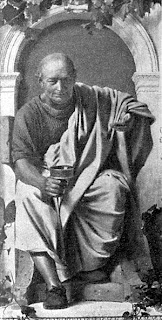
Quintus Horatius Flaccus revisited

Several weeks ago I was straightening up some of my older books (i.e. trying to figure out what I had) and came across my highschool text of Latin poetry: selections from Catullus, Vergil, Horace, and some Martial. I also looked up my Penguin Classic translation of Horace, since my Latin is more rust than iron, to rediscover what I found so fascinating about him.
Horace, after fighting with the losing armies of Brutus after Caesar's murder, ended up becoming almost the unofficial poet laureate to Augustus. Virgil introduced him to Maecenas, a friend of Augustus who became his patron; he had a position with the government if he wanted it. With all that time and financial support, all he needed was talent. He had that.

Let him explain what he did. He claims to have taken the old. staid and solemn Latin forms and rhythms and urged them into older but more elaborate Greek lyric stanzas. He also shunned as much as possible the solemn poetry praising battle and empire that Augustus asked for, praising instead the little things he knew and held dear. In that way he was a forerunner of modern populist poets.

So. Instead of armies marching to war he wrote about country life, village and farm. Instead of triumphant generals celebrating victory, friends and acquaintances having a few drinks, joking around, talking about girls. Such a welcome change from Vergil's solemn Aeneid. With irony and self-deprecation he kept his personal life out of the poems. Rather than beg for emotional response, he presented the image; he was the first to claim that a poem must make the hearer "see" what the poet had in mind, the image of the imagination.


After two millenia, Horace still speaks with a voice that resonates today. His images captivate; his forms and metrics intrigue. Now to search for that Epistle, his "Ars Poetica."

Tuesday, March 10, 2009

Meaning and Poetry (3)

We've looked at different ways poetry can carry meaning. There is the apparent meaning which is conveyed by the words and images used. Delving a little deeper, we could find meaning in the connotations those words carried or the emotional references attached to them. Then, of course, there would be obscure or esoteric meanings, some that may not have been meant by the author. But underneath it all, a good poem can impart meaning by its structure.
By this I don't refer to such obvious devices as a Christmas poem in the shape of a bell, or any poem in any external concrete form. Let's look at the formats that have stood the test of time and are still in use. The sonnet is a solemn form, used to explore emotional themes and conclusions. Heroic couplets in which each two lines rhyme seem usefull to teach or preach. You could never do that with the quick, laughing form of the limerick nor with the dance-like repetition of the villanelle. Can you imagine Robert Services ballads in any other form? The line length and rhythm make an excellent conveyance for his tales. They would not lend themselves to express the solemnity found in a sonnet, nor the wit and dash of a limerick. Each form provides a well understood basis for its expression.
What happens too often in so-called free verse is that beneath all the words and images there is no trace of any structure. A poet who begins from structure and language and poetic devices will have so much more at hand to impart his meaning: literal, symbolic, emotional, or hidden. Certainly there is no rule that structure should be evident but a poem that holds together the way such forms tend to hold them will be that much stronger in its impact.
Even though you cannot immediately see the structure underlying a poem, you should be able to feel it. It is the backbone, the strength of a good poem. Structure carries meaning and also makes the poem memorable.

Sunday, January 25, 2009

Robert Burns, poetry, and nationalism

Today is Robert Burns' birthday. Scots in Scotland and all over the Americas, Scots in Australia and a dim corner of Uzbekistan; wherever they may be they celebrate. They celebrate with dinners and speeches. They celebrate with haggis and pipers. They celebrate with Scotch whiskey. But most of all, they celebrate poetry with poetry.


What makes Burns so important? Even a Scot can't articulate precisely the what and how and why. What happened, and what many Scots began to realize when he died, is that this man captured the soul of his people and laid it out before them in all its natural wonder. He did so in language that they not only understood but also used every day. He set it to the music that whispered through their bodies in a manner they couldn't forget. They made him their national poet, even when the people had no definitive nation as such.


Every nation, every people needs a poet who becomes their soul. And especially Canada needs a poet to express the heart and soul of the people. In this time of need, the call is being answered.


Since Al Purdy's death a focus has grown around the poet and what he means and expresses about the people of Canada. He has been acclaimed as the "Voice of the Land." A greater-than-life sized statue of him has been erected in a prominent public place. The home he built out of "second hand lumber and poetry" is the object of a movement to save it for those to come.


A better national poet we could not want, a Robert Burns for us and our times. This movement is rooted much deeper than any personality cult and can become a focus of Canadian culture. an expression of we, the people.


Burns and Purdy

The twenty-first day of April should be Al Purdy Day. Make it so.