I've always wondered about that Christmas song, the what and the why of the true love's gifts. This season I found an interpretation that suits it and makes perfect sense if you see it in the context of the persecution of Catholics in seventeenth century England. Memorizing the doctrines as a song was a perfect way of not needing incriminating religious materials.

THE TWELVE DAYS OF CHRISTMAS
On the 1st day of Christmas my true love gave to me...A Partridge in a Pear Tree
The partridge in a pear tree is Jesus the Christ, the Son of God, whose birthday we celebrate on December 25, the first day of Christmas. In the song, Christ is symbolically presented as a mother partridge that feigns injury to decoy predators from her helpless nestlings, recalling the expression of Christ's sadness over the fate of Jerusalem: "Jerusalem! Jerusalem! How often would I have sheltered you under my wings, as a hen does her chicks, but you would not have it so . . . ." (Luke 13:34)
On the 2nd day of Christmas my true love gave to me...Two Turtle Doves
The Old and New Testaments, which together bear witness to God's self-revelation in history and the creation of a people to tell the Story of God to the world.
On the 3rd day of Christmas my true love gave to me...Three French Hens
The Three Theological Virtues: 1) Faith, 2) Hope, and 3) Love (1 Corinthians 13:13)
On the 4th day of Christmas my true love gave to me...Four Calling Birds
The Four Gospels: 1) Matthew, 2) Mark, 3) Luke, and 4) John, which proclaim the Good News of God's reconciliation of the world to Himself in Jesus Christ.
On the 5th day of Christmas my true love gave to me...Five Gold Rings
The first Five Books of the Old Testament, known as the Torah or the Pentateuch: 1) Genesis, 2) Exodus, 3) Leviticus, 4) Numbers, and 5) Deuteronomy, which gives the history of humanity's sinful failure and God's response of grace in the creation of a people to be a light to the world.
On the 6th day of Christmas my true love gave to me...Six Geese A-laying
The six days of creation that confesses God as Creator and Sustainer of the world (Genesis 1).
On the 7th day of Christmas my true love gave to me...Seven Swans A-swimming
The seven gifts of the Holy Spirit: 1) prophecy, 2) ministry, 3) teaching, 4) exhortation, 5) giving, 6) leading, and 7) compassion (Romans 12:6-8; cf. 1 Corinthians 12:8-11)
On the 8th day of Christmas my true love gave to me...Eight Maids A-milking
The eight Beatitudes: 1) Blessed are the poor in spirit, 2) those who mourn, 3) the meek, 4) those who hunger and thirst for righteousness, 5) the merciful, 6) the pure in heart, 7) the peacemakers, 8) those who are persecuted for righteousness' sake. (Matthew 5:3-10)
On the 9th day of Christmas my true love gave to me...Nine Ladies Dancing
The nine Fruit of the Holy Spirit: 1) love, 2) joy, 3) peace, 4) patience, 5) kindness,6) generosity, 7) faithfulness, 8) gentleness, and 9) self-control. (Galatians 5:22)
On the 10th day of Christmas my true love gave to me...Ten Lords A-leaping
The ten commandments: 1) You shall have no other gods before me; 2) Do not make an idol; 3) Do not take God's name in vain; 4) Remember the Sabbath Day; 5) Honor your father and mother; 6) Do not murder; 7) Do not commit adultery; 8) Do not steal; 9) Do not bear false witness; 10) Do not covet. (Exodus 20:1-17)
On the 11th day of Christmas my true love gave to me...Eleven Pipers Piping
The eleven Faithful Apostles: 1) Simon Peter, 2) Andrew, 3) James, 4) John, 5) Philip, 6) Bartholomew, 7) Matthew, 8) Thomas, 9) James bar Alphaeus, 10) Simon the Zealot, 11) Judas bar James. (Luke 6:14-16). The list does not include the twelfth disciple, Judas Iscariot who betrayed Jesus to the religious leaders and the Romans.
On the 12th day of Christmas my true love gave to me...Twelve Drummers Drumming
The twelve points of doctrine in the Apostles' Creed: 1) I believe in God, the Father almighty, creator of heaven and earth. 2) I believe in Jesus Christ, his only Son, our Lord. 3) He was conceived by the power of the Holy Spirit and born of the virgin Mary. 4) He suffered under Pontius Pilate, was crucified, died, and was buried. He descended into hell [the grave]. 5) On the third day he rose again. He ascended into heaven, and is seated at the right hand of the Father. 6) He will come again to judge the living and the dead. 7) I believe in the Holy Spirit, 8) the holy catholic Church, 9) the communion of saints, 10) the forgiveness of sins, 11) the resurrection of the body, 12) and life everlasting.
It's very reminiscent of another aide-memoire, the song/recitation (rewritten in 1948 by T. Texas Tyler and probably best remembered as performed in the late fifties by Wink Martindale) "Deck of Cards," about a soldier caught playing cards in church.


 That was a concept I could understand, could apply to my own questionings. It is the main bit of knowledge I'll remember from the festival. And the most valluable.
 It seems the main purpose is to put together only beautiful words, to form images, metaphors and similes that have not been used before, that sound fantastic and outrageous. The problem, in her mind and mine, seems to be that no one cares about the meaning of the poems anymore. Poetry has become, using Shakespeare's image, "sound and fury signifying nothing."
 Now I'm all for the beauty of language, for the magic of sound spoken or unspoken. I believe it is and must remain an integral part of poetry. Inflections, rhythms, rhymes, alliterations, assonances and all the underlying music is the root of poetry. But ...

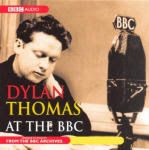 It is hearing him read, hearing his delivery of the sound and music of the language, that opens the way to an understanding of the meaning of his words and the ideas these words express. "I am a painstaking, conscientious, involved, and devious craftsman in words, however unsuccessful the result so often appears." Words and the way they are used, new expressions shaped from old, all may look odd on the page but resound like church bells in the air around.
 Thomas is by no means the only poet who should be heard before he is read. I had but a faint grasp on the poetry of bp nichol before I heard him read it aloud. The dub poets need the voice to convey what the page can not. Any good presenter of his/her own poetry must add something more than can be found displayed in black text on white paper.
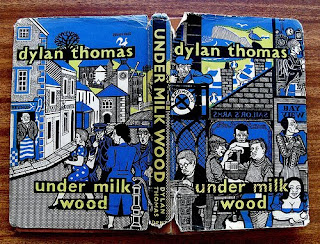 Let's keep the words and language ringing.
 He encouraged and supported T. S. Eliot's poetry. Eliot's "The Wasteland" became the premier example of modernist poetry, using all the techniques and rationales the writers proclaimed. In the field of the novel, James Joyce worked these into Ullyses and later Finnegan's Wake.
 But with a critical look, the jumble of stones, the collage of different ideas and phrases, become more that what is first apparent. They point at and even carry a beauty of their own. Words and phrases, ideas and concepts, they begin to connect, to form random patterns as if tossed for the I Ching. Perhaps this is partly due to Pound's study and work with traditional Chinese poetry.
 Cadence and pattern. These become for Pound and the moderns the antidotes to stale phrases and metrics. And this is where today's poets make their mistakes. Free, they proclaim, is free from those old ideas and they leave it there. They forget to use the replacements. Their jumbles of words have no connections or no cadence. A framework must exist or all will be washed away to be forgotten. Those who count syllables may carry on for a time; they have established a pattern. However, unless that pattern is translated into a discernable cadence (which does happen in the best) such poems too become unmemorable. And unmemorable is not what a poem should be.
 Before I could let things settle in my mind, the music and song became nothing but (to me) shouts and epithets about crime, sex, violence, and gangsterism. What's more, the practitioners seemed to live it out in the media.
 Four guys swapping rhymes among each other on stage, an easily discernable line of protest running through their words and their actions. Movement, language, attitude, all carefully orchestrated into an almost flawless presentation over a prerecorded rhythm track. It was more than enough to send me to find out what hip hop, rap, etc. was really all about.
 A little research: hip hop as develloped among black urban youth has much of the same basis as Dub poetry from Jamaica; that began when DJs would rhyme their own words (dub) over the B sides, usually instrumental versions, of popular reggae songs. Take away the music but leave the rhythm and rhyme, especially when it has been taken away from extemporaneous and become finely honed set pieces. You have an accepted and understandable form of poetry that is immediate and vernacular.
 With the beat in my blood and the rhymes in my mouth and the cry for justice in my heart, I too am a part of hip hop.
 Now alliteration in moderation is a good and powerful tool for the poet, more so than for any other writer (except the producer of tabloid headlines!). Old English poetry was founded in alliterative four-stress lines. The sound of a sound repeating itself is often a baby's first attempt at language. Alliteration and assonance, its concomitant construction, (two deliberate examples of alliteration) are a vital part of the language. The question still remains, When is it a game and when is it poetry?
  Nursery rhymes that depend on word play, are they considered lasting poems comparing favourably with Old English riddles? Lewis Carrol's "Jaberwocky" can be found in anthologies of Victorian poetry. Why then isn't Joyce's Ulysses a great poem of the twentieth century? Closer to home is Christian Bok, an experimental and "sound" poet. What makes his Eunoia such a popular and critical success? His gathering of words, divided according to their use of one vowel, is the ultimate in word play - the result of years of making lists. Sound (and assonance, therefore) is everything; sense and meaning are far down those lists!
 Abstract art: abstract poetry. You endow the words and sounds with whatever meaning you want to fit. So play word games. Play Scrabble, do anagrams, acrostics, crossword puzzles. I like them too. I just don't call it poetry.

 I suppose that argument has its merrit but I tend to disagree. Throughout the history of poetry, the use of proper names has made poems stronger by their particularity and their emphasis. One example that keeps pushing to the forefront is that of Browning's "My Last Dutchess." In his poem, we never learn the lady's name; this lessens her importance and emphasizes the importance of the Duke himself. Compare that with the repeated naming of the artist, Fra Pandolf, and the impression left of the Duke as a rich man of fine artistic taste. The same still happens today: someone will claim to have a "Van Gogh" rather that a painting hanging on his wall.
  By naming, by using proper names, the poet establishes a personal connection to the person/place/thing he names. In doing so he displays a connection which is important to the poem, more important than the thing named or the poet himself. It should be this connectedness that resonates with the reader; it then does not matter if the reader has knowledge of the thing/place in itself, as long as he can identify with that sense of connection in himself. Place, poet and reader become secondary to the poem and its expression; they become connotations of the primary idea.
 By this I don't refer to such obvious devices as a Christmas poem in the shape of a bell, or any poem in any external concrete form. Let's look at the formats that have stood the test of time and are still in use. The sonnet is a solemn form, used to explore emotional themes and conclusions. Heroic couplets in which each two lines rhyme seem usefull to teach or preach. You could never do that with the quick, laughing form of the limerick nor with the dance-like repetition of the villanelle. Can you imagine Robert Services ballads in any other form? The line length and rhythm make an excellent conveyance for his tales. They would not lend themselves to express the solemnity found in a sonnet, nor the wit and dash of a limerick. Each form provides a well understood basis for its expression.


 Even then, the poet should not be surprised if someone ascribes to his work a totally subjective meaning or interpretation. The wash of language can validate almost any meaning. The surrealists taught us that.