Showing posts with label words. Show all posts

Tuesday, August 17, 2010

Language Irritation

I just want to complain about a strange construction I have been finding in works published in the English language. For a long time I have heard it in the spoken language but have not, until recently, discovered it in a newspaper as well as a novel from a very respected publisher. Here it is:

One of the functions of the infinitive mood of a verb is as a noun. The infinitive is expressed with the preposition "to," as in "to find," "to make," "to have." Why, when an infinitive is a noun serving as object to a verb, should it be changed to a correlating verb connected by the coordinating conjunction "and"? Do you understand? Allow me to try to explain.

That construction is correct, but so many will say "try and explain." Even tense doesn't matter. Instead of saying " She came to see me yesterday" the tenseless infinitive takes on the relative preterite as "She came and saw me yesterday."

The examples could go on and on. The recent construction probably grew out of speakers' laziness; it is so much easier to say "and" instead of "to" especially when it can be slurred to " 'n' ."

So. Should we live with it or try and do something about it?


Tuesday, August 10, 2010

Attitude Poetry

There’s a fellow poet with whom I was discussing the basics of poetry not long ago; on some things we agree but on others we don’t. That, I suppose, is to be expected.

We both agree that language is basic but each has a different emphasis on the way it should be used. I prefer to keep my words and expressions working the way they usually do. Nouns name things, verbs are action; adjectives describe nouns, adverbs explain action. They fit together in phrases and clauses. My friend will often turn a noun into a movement or a verb into a thing. That’s not new; we “squirrel” things away; a wave is an action or a thing. He just likes to do the same with words we don’t think of using in such a way.

He claims it helps establish “attitude.” Attitude, he says, is the second most important principle of poetry. Here we disagree. Rather than something as tenuous as attitude, I prefer to emphasize the tools used to make poetry —similes, metaphors, images, sound, rhythm, and shape — something he puts much lower on the list. So I began to consider attitude as an integral part of poetry.


Several instances that seemed important crossed my mind.
One occurred when someone read one of my poems before a group; he read it as words on the page, without the expression I would have given the delivery, without my “attitude,” if I could consider it like that. The second, strangely enough, was Cassius Clay/Muhammad Ali with his ‘poems’ not only predicting the outcome of his fights but also the descriptive “Float like a butterfly, sting like a bee,” phrasings that were new to the prizefighting game. Ali had attitude, physical and verbal. His words, his poetry, caught the ear and demanded attention.


I’m quite sure that this was what my friend meant by claiming poetry must have attitude. If a poem doesn’t grab and shake its hearers, it might pass away as if it had never been. And in a way this is also a valid point, this emphasis on attitude.

Jamaican-born Dub poetry grew out of this sensibility. Dub doesn’t live by the written word; its vitality lies in its performance. I grant that the tools of poetic language (rhyme, rhythm, etc.) are a vital part, but its attitude is most recognizable. Similarly today’s slam poetry with its aggressive and competitive aspects depends on attitude more than on well-formulated thought progression.

The question of attitude remains for me a matter of balance. Certainly a poem needs something special to make it stand apart from the common flow of words in our lives. However this expressiveness, this attitude, can become a cover hiding flaws, a thick coat of paint over the incipient rot in the wood.

After consideration this emphasis on “attitude” my friend espoused has moved up somewhat in my view of poetry and poetics. But care must be taken. It is too easy to push too hard, to blow too loud, and defeat the whole purpose of the attitude.


Sunday, June 20, 2010

Honorifics


Indulge me for a few moments; I need to get something off my chest, as they say.

An acquaintance of mine recently completed the work and was awarded a Ph D in some field of science. I congratulated him, wished him all the best. With tongue planted firmly in cheek, I suggested that all we unschooled peons would now be obligated to address him as “Doctor B-----.” To my surprise he agreed, quite adamantly in fact. At first I could not believe he was serious.

He worked very hard to attain this goal, he argued. Just like a doctor in a medical field, he should be given the respect due to him, just as it says on the diploma he will hang on his office wall. He gained a level in education, he said, but also standing in the community.

I was puzzled. I told him I could see that sort of respectful salutation from fellow scientists, etc., but certainly not from store clerks, plumbers, auto mechanics and the like. Certainly he wouldn’t ask it of friends in the pub, the guys he plays squash with? Any one who is aware of my degree, he proclaimed, to whom I was introduced as one holding such a degree, has an obligation to honor me, to show respect.

Shaking my head I slipped away, wondering how long this would last and glad he wasn’t a close friend.

However, that reminded me that I don’t like honorifics; not so much that they nauseate me but I have a strong aversion to them. Let professors be “Professors” in class or on University business; to me he is Sam from down the street. In conversation you may refer to a surgeon as “Dr. W----,” but I’ll tell you that I know Maria W----. In the office, with a professional relationship established, she is “Dr. W----.”

What’s more, it goes against my grain to use the everyday honorifics we use as courtesy. They are not inherently polite, but reflect a hierarchical social structure I would rather not propagate. Women were right when they no longer wished to be addressed as either Mistress or Miss depending on their marital status, because such status was irrelevant. They didn’t go far enough. They should have eradicated all such “honorable” forms of address rather than reduce it to a noise that is part hum, part buzz, and completely silly. Ms. “Mmmmzzzzz.”

The trouble with mister/master/mistress is that it is based in and continues to remind me of master-servant or even owner-slave relationships. I don’t recognize such and refuse to consider anyone my “master” or to be anyone’s “master.” On the other hand, I also dislike being addressed as “sir.” It too has that air of social distinction, of setting the speaker in a lower rank than the one addressed, obsequiously bending the knee and begging for a gift from a noble hand.

Most courteous honorifics are dishonorable. Even “comrade” as a form of address, as expounded by communist regimes in the past century, does not sit well in my mouth.

We had it as nearly right as we could get it at one time, I believe. In the late sixties, early seventies we addressed each other as “man.” A simple appellation and not necessarily sexist for a woman told me she considered it to be “apostrophe-man,” a contraction of “human.”

And let me tell you ‘man, it gets no better than that.


Saturday, May 22, 2010

The Poor Man's Riches


Some time ago I was listening to a BBC interview with the Australian poet Les Murray about the compilation of a distinctly Australian dictionary, the Macquarie Dictionary. One of his casual remarks, one of several I would have liked to hear him expound, was that “words are the poor man’s riches.” That left it up to me to think it out for myself.

I considered where new words come from. A number come from writers for ad firms or politicians, those using language to sell goods, services, actions, or personalities to people not as linguistically nimble. (Cf. the Afghanistan war: the precision of technological weaponry vs. the dreaded roadside IED, the Improvised Explosive Devise or as the military don’t want to put it, “home-made bomb.”) But many more begin among those who are not a part of the mainstream of business, culture, government, or other such matters. A richness of words has always come from the poor.

The language is infiltrated, and usually enriched, by the acceptance of slang. I can remember when it was not proper to refer to children as young goats; now even the most refined parents will praise their “kids.” When I was young I used to laugh and sing: I was gay. I still laugh and sing but I am no longer “gay”; the primary meaning of the word has been changed. As an activist in the 1960s I found the most powerful word referring to authorities was the little word “pig.” However, it has now lost much of that ability to aggravate and irritate because it became common if not quite acceptable.

Words continue to take root among our common “word-hoard,” our treasury of language. They come from the usage of criminals and other marginalized people, or from groups who have developed a need for a common terminology that then spreads into common usage (e.g. words from the surfer and hippie subcultures, “Valley-speak,” hip-hop terminology.) Words from banking and business do occur but have far less chance of becoming part of our daily speech unless propagated through extensive media usage.

When words are the only resource you have you learn to use them with discrimination. You become aware of their strengths, what they can do for you and to you. It is only a small step from realizing the power of words to seeing their value. If money is power, then the power of words is riches. Who knows this and uses it carefully will never be poor.

Blessed are the rich in language for they are the rich in spirit.

Friday, May 21, 2010

Diminutives in Language

I just want to take a moment here to expound on one of my few bugaboos of the English language, a fact I have learned to tolerate but not to like. I think the language would be more fully rounded, in a sense more musical, more pleasing to the ear, if it had a predominant and consistent suffix to express both comparative smallness in size and familiarity or endearment. Other languages do, and I admire the way it works for them.

Let’s take a look at two different languages. Spanish, as an example of the Romance languages, employs a few diminutive forms quite readily, e. g. “–ito (m), -ita (f)” and “–illo (m), -illa (f).” Dutch, like English a Germanic language, uses “-je” (often with a preceding consonant) to designate small size or familiarity; the diminutive is used with nouns, names, adjectives and other word forms.

It’s not that English doesn’t have diminutives, it’s just that nearly all of them are borrowed from other languages: -ette (et) from the French creating words like parkette and caplet. From Old Norse comes “-ing” in duckling and darling (familiar for “dear”). The “-y” or “-ie” comes from the Scottish (who themselves use an adjective “wee” rather than a suffix.) The Germanic “-kin, -ken” is very infrequent.

The problem is that none of the suffix constructions are productive, that is, used in common word formation in daily speech. And that, in my opinion, is one of the greater flaws of the English language.


Wednesday, March 17, 2010

Words and Music, Certainly

I have come to understand that the music that moves me is usually associated with language. That is to say, a composition consisting of musical notes and depending on that alone does not touch me as deeply as a well-phrased song. I am trying to understand why.


This meditation comes out of a concert I attended recently, and the comparison I make with different concerts I remember. I can listen to classical compositions and enjoy the sound patterns, perhaps even feel a vague emotional response to it. I can follow the intricacies of a jazz number and be astounded by the separate reality it may portray to the contemplating mind. But it is songs that I remember most vividly. Not necessarily the poetry of the song although that seems to be a strong component. It is the combination of words and music that touches me deepest


The concert by Big Rude Jake about ten days ago is a good illustration. I had seen him fronting a neo-swing type band about eight or so years ago but heard that he had refined his sound to more of a singer-songwriter style presentation. I enjoyed it even though I approached it somewhat skeptically. I tried to analyze what it was about his concert that impressed me and came up with these facets: he had the poetic sensibility of a Tom Waits, the musical ambiance of a Leon Redbone, and the ‘fun’ jazz styling of Big Rude Jake. I was moved and impressed.

But several days later I came across a phrase that, although here it was in a totally different context, reminded me of a song that had moved me to tears many years ago. I pawed through my extensive record collection and found the original recording. When I played it again for myself, the tears flowed again. And again, every time I played it or sang it to myself. This is one of a small number of songs that affect me that way. With each one, I can remember where I first heard it, with whom, under what circumstances. I cannot say the same about any other piece of music that has no vocal component.

So it seems my true appreciation of music depends on language. I don’t know if this is unusual, whether it is a part of my being a poet, a wordwright or something like that. The realization that such is my nature does help me understand myself.

It helps explain my affinity to old blues, story songs, and music surrounding literate imagery.


Friday, March 5, 2010

FUCK, the Word

This simple little word has such an unsavoury reputation. For many centuries it has been considered unspeakable, even filthy and wicked. This reputation, however, is changing. It drips from the mindless lips of old men and bubbles from the mouths of infants. As far back as 1972 the Oxford Dictionary decided to include it, only noting that it was considered "vulgar."

What brought on this meditation on the word was not the "fuck you" scream of a preschooler, nor the "fucking awesome!" exclamations of jubilant adults watching the Winter Olympics. I can understand its use in times of stress and emotion, when vocabulary is not the easiest thing to access. But when a poet, a person who should be familiar with words and language, the so-called tools of their trade, calmly describes someone they don't like as a "fucking dog," something is wrong. Certainly the term expresses clearly the high level of contempt implied but the true descriptive powers of language have been completely circumscribed. And such activity should concern anyone working with words.

Fuck is such a beautiful and useful little word. It was probably used in the earliest times of the English language with the simple meaning "to breed, to fornicate." All Germanic languages have a cognate from a common root; most have not been as unfortunate in their treatment.

Two things took away the ease and familiar usage of the term. First was the heavy influx of French and Latin through the Norman conquest so that their terminology took precedence. Second, and related, was the feudal system of land ownership and power, setting administration apart from the common people. After all, "vulgar" does mean "of the common people."

So the word languished outside of the vocabulary of all those who mattered until recently. In the twentieth century, public personalities, be they revolutionaries or simply social agitators, began to slip the word into their speech and writing. But not just as a little verb. They found it so versatile that it could be used as any part of speech.

It is a verb, both transitive and intransitive, i. e. you can simply "fuck" or you can "fuck someone/something". It can be used as a noun, as "a fuck" or "a fucker." It can be used as an adjective, "the fucking car." It will serve as an adverb, "so fucking good." It becomes an interjection, "Oh, fuck!" And the use most distasteful to me, as an intensifier, "he's so fucking smart ..."

I know the language continues to change and that there are no rules that can be enforced. I am not against vulgarities: I claim to be vulgar, one of the common people. All I ask is that we don't forget the other words in the language just because this one is so versatile.


No, no! "May a swarm of honey bees build their hive in your rectum!"

That's what language is for.

Wednesday, February 3, 2010

Gender, No Sex


Rather than offering a broad scope of philosophy or literature, this time I want to get down to a small but personal irritant in the English language. In its development English has overcome most of the strictures of gender and number of nouns and pronouns in the language. The most glaring anomaly is the third person singular when gender is not neuter but unknown. Even the present tense verb form changes for the third person singular.

We say that I, you (both singular and plural), and they make but he, she, or it makes. The question raises its head when we refer to a person but not his (or her) sex. See how awkward this gets?

When I was learning the English language (for it's not my mother tongue) I was blithely taught that the masculine "he (or him, his)" when used in this way presumed the inclusion of the feminine "she (or her, hers)." And that explanation of inclusiveness satisfied me for a long time. But a decade or two later the feminist social movement raised a fuss about such language, not only about the third person singular but also about non-gender specific nouns automatically being assigned the masculine singular pronoun. First they did away with suffix identifiers such as -ess, etc. There are no more actresses; they are all actors. Even God in her wisdom will take on the feminine form.

Sometimes it becomes silly and goes overboard, e. g. the use of the term "herstory" when the original "his" doesn't have any connection with gender. Or when a "manhole" becomes a "personhole." You may notice that this is never applied to already derogatory terms; you won't find anyone referred to as a "womaniac" or "personiac" no matter what the sex of the individual.

But back to the gender of person. What do you say when you don't know the gender of the person referred to? "Whatever the doctor tells you, do what he/she says." To go back to the time I was taught English, we were also told that the pronoun form "they, them, theirs" is plural and not to be used for the singular. Then the teachers threw in exceptions: you may use it in the case of singular collective nouns such as "the crowd raise their voices" or "my family always take their vacation." (Note that the verb form also becomes plural.)

I read in a neat little book that the third person plural had been used to fill this gap for a long time, by such people as Shakespeare, the authors of the King James Bible, Jane Austen and others until the latter part of the nineteenth century when there was a concerted effort to regulate the language, an effort that led to the rule against ending a sentence with a preposition and other awkwardnesses. But English with its very adaptable nature will not be regulated.

Therefore, I will end a sentence with a preposition if I need to. I intend to use "they" for the third person singular pronoun if gender is unspecified. But I'll listen to any person who thinks they can find a better way.
Sometimes you can teach this old dog a new trick.

Thursday, December 10, 2009

Sounds of Poetry

Let's be clear from the start. This entry is not about 'sound poetry,' the use of sound as opposed to words as a means of poetic expression. Here we are dealing with the sounds that are language, that form the words we use, and especially of those sounds as they take part in our poetry.

Two incidents brought this to mind recently. First I had taken my cat to the veterinarian for his annual checkup and necessary booster shots. When we got home he was quite put out and avoided me. Some time later I lay down on the bed and invited him to join me. He did, and after some time ended up lying against my chest, purring. In return, I hummed deep in my throat and chest in response. We quietly lay, side by side, exchanging vibrations. It reminded me of how a mother will use a wordless hum to soothe a fussy baby.

Now for the second influence. I was reading a passage of poetry aloud to myself when I noticed that the author had used an unusual number of 'm' and 'n' sounds in one of the four line stanzas, and the soothing effect (much like the cat or a baby) that had on me. I had read the poem before, but never aloud. I was so intrigued that I read the poem again several times, this time emphasizing and lengthening those sounds. Granted, I sounded as if I suffered from an acute stammer, but it certainly heightened the effect.

I thought about how poets when they read their work aloud in public seem to ignore the importance of sound in favour of putting across the meaning of the words. Seldom is there any lingering over a single sound or emphasis on a series of sounds. And sound is so important to poetry. We use its repetitions to enhance our words: rhyme, both at the ends of lines and internally, and with its many elaborations; alliteration, the repetition of initial consonants; assonance, where the vowel sounds repeat but not the consonants; consonance, where the final consonants agree in sound but the vowels do not. And, of course, the many variations of these.

So if a poet goes to all that trouble to use it in the written word, why not note it in the spoken? It doesn't take much. It is not necessary to stop so long that the silence underscores it, or to voice it in such a way as to bring undue attention. The simple answer is to read slower. If we read slower than normal speech (and speech in modern times has tended to quicken noticeably), the hearing ear can catch patterns of sound that could easily pass ignored. Those patterns of sound are as much of the poem as the words and meaning.

So, poets at the mike. Slow down the tumble of words; sing out the sounds.


Monday, September 21, 2009

The Inherent Rhythm of Language

The other day a lady friend of mine brought a new poem to a workshop we both attend. Her poem surprised me because it was not in her usual style, longer lines with almost no sense of a cohesive rhythm. This time she had done something completely different.

Not only were the lines short, almost all the same length, but she had marked (and left those marks on the page inadvertently) each line with the number of syllables she had used. Most lines were four syllables, with the occasional use of five or three.


Now I'm not one to advocate counting syllables in poetry instead of using and playing with established rhythms, but in this case it worked. It helped that she used a four syllable line, most usually of two words; in English it seems difficult to put four syllables together without ending up with an iambic dimeter or a close variation thereof with a trochee or spondee. There seems to be no way a unit of four syllables can stand without at least one, and more comfortably two stresses. And this becomes a natural iambic rhythm, pleasing to the ear and to the mind.

This started me reflecting on the natural rhythms of languages, especially Indo-European languages with which I'm familiar. For me, iambic feels so right for English, (much more so than for Old English and even Middle English.) daDUM daDUM daDUM daDUM seems to roll so fluently from the throat. On the other hand, German, Dutch, etc. seem to come into being as a stream of trochees: DUMda DUMda DUMda DUMda.
French, again, has another and separate rhythm pattern expressed (to my ear) in anapests, dadaDUM dadaDUM dadaDUM dadaDUM (see Gilles Vigneault's "Mon pays ce n'est pas un pays c'est l'hiver.") The foot my ear finds most often in the Italian language, and I believe also in Spanish, is amphibrachic, with the stress on the penultimate of a three syllable foot, daDUMda daDUMda daDUMda daDUMda.


Ah, marvel at the subtle intricacies of the rhythms of language! Truly it is a reflection of the music of the spheres, the sound of all things working and singing together!

Monday, July 6, 2009

Pain and Art

It's commonly accepted that art can often be the result of pain, whether it be physical or emotional. Artistic expression may come in response to pain or as a way to deal with it. Painters and photographers, musicians and writers, no matter the medium it has been used to convey pain, its effects and consequences.

My question comes from another angle. Has art and its expression ever been used to deliberately cause pain?

A few evenings ago I was at an outdoor concert of reggae and other Carribean music. To emphasize the beat, the rhythm, the promoters and/or the musicians turned up not only the volume but also the bass. I found it necessary to leave.

I used to laugh at my wife when she refused to stay at a concert with a pronounced and heavy bass because it hurt her. Not her ears so much as her bones, she said. Myself, I would joy in the vibrations of my own body to the rhythm of the pounding beat. Pain, no; discomfort, maybe but the excitement was worth it.
That night, the bass vibrated my bones: ribs, breastbone, collarbones. What's more, it hurt. After several minutes the pain throbbed as constant as a toothache and I had to leave.
It made me wonder. Has sound as art ever been used to destroy its 'consumer'? Has any other art form? I know good writing has been used as fuel for political movements, but has a combattant ever been killed by a poem? A barrage of poems?
Art is an antidote to war, anger and negative behaviors but can it ever stop it without the bodies of the artists?

Buffy Sainte-Marie's Universal Soldier is as strong as ever. Over against him is the Universal Artist. But, may sounds and looks and words never kill. It's more than enough that they hurt.

Thursday, June 11, 2009

The Sound of Emptiness

An acquaintance of mine who is involved in the poetry scene in the big city tells me there is a "new wave" in poetry happening at open mikes. I forget what she said they call it.It seems the main purpose is to put together only beautiful words, to form images, metaphors and similes that have not been used before, that sound fantastic and outrageous. The problem, in her mind and mine, seems to be that no one cares about the meaning of the poems anymore. Poetry has become, using Shakespeare's image, "sound and fury signifying nothing."

Now I'm all for the beauty of language, for the magic of sound spoken or unspoken. I believe it is and must remain an integral part of poetry. Inflections, rhythms, rhymes, alliterations, assonances and all the underlying music is the root of poetry. But ...

When there is no meaning there is nothing communicated. When poetry becomes such a solitary pursuit that it doesn't matter if no connection between human beings is sought, why bring it out before the public at all. The only joy is the stroking of the ego that fabricated it. For the rest of us it remains an inexplicable emptiness.


I myself have used images in non-traditional ways, using them to build a mood or a level of emotion. In such a role, the words and sound of the words take on a greater meaning not obvious at first. But I would never claim that they didn't mean at all, conveyed only what the hearer/reader wanted them to mean.

Is this where postmodernism and the deconstructionists have led us?

Wednesday, May 27, 2009

Listening for Dylan Thomas

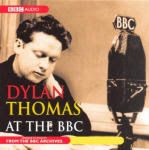
In my eclectic reading recently, I came across Dylan Thomas' essay on his poetics titled "Notes on the Art of Poetry." It brought to mind one of the reasons that I am so entranced by poetry, and especially the delivery of it to the audience.

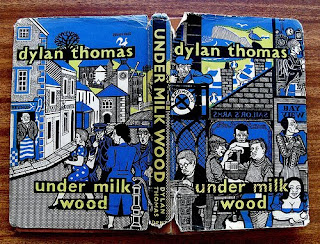
In it Thomas speaks of his fascination with the sound of words, beginning with nursery rhymes as a child. The sound and substance of words came first for him; things like meaning and communication of ideas were secondary. This emphasis on the sound of language permeates most if not all of his poems; it plays a great part in his stories; it is integral to his radio plays. Under Milkwood, his famous play for voices, is probably the greatest example of prose and poetry combined in one work since Shakespeare.

If you're going to make yourself more familiar with Thomas' work, your best approach would be to hear it. Because of his experience working in broadcasting during WWII, he recorded much of his work and much of it is still available.
It is hearing him read, hearing his delivery of the sound and music of the language, that opens the way to an understanding of the meaning of his words and the ideas these words express. "I am a painstaking, conscientious, involved, and devious craftsman in words, however unsuccessful the result so often appears." Words and the way they are used, new expressions shaped from old, all may look odd on the page but resound like church bells in the air around.

Thomas is by no means the only poet who should be heard before he is read. I had but a faint grasp on the poetry of bp nichol before I heard him read it aloud. The dub poets need the voice to convey what the page can not. Any good presenter of his/her own poetry must add something more than can be found displayed in black text on white paper.
Probably because I come from a people who relied on public recitation as a form of community entertainment, on "foardragen," poetry and its presentation aloud mean so much to me. But that's not the only reason. I too love the sound of words; at times I don't care whether or not they mean. In a way it's like opera: who cares what banalities the words may mean, they sound so marvelous!

When I remember Martin Luther King proclaiming, "Let freedom ring!" I hear in my own mind, "Let poetry ring!" Sometimes freedom and poetry are expressions of the same thing.

Let's keep the words and language ringing.


Wednesday, May 13, 2009

The Hip and the Hop

Right from the beginning, I never liked hip-hop: the breakdancing, the clothing, the graffiti "art," the music and its "poetry," the sideways ball cap attitude. It seemed vain and meaningless to me, rebellion for the sake of rebellion.Before I could let things settle in my mind, the music and song became nothing but (to me) shouts and epithets about crime, sex, violence, and gangsterism. What's more, the practitioners seemed to live it out in the media.

My attitude and acceptance are changing.

It began with an East Coast artist who calls himself Buck 65. I heard him on the radio one day and his lyrics, though delivered in true rap style, made sense in a way the rap and hip-hop thing never had before. But, I figured, that's just an abberation. Then at the Skydragon Mayday celebration a group calling themselves "Rhyme Travellers" performed on the stage and I got the whole thing live and in my face.
Four guys swapping rhymes among each other on stage, an easily discernable line of protest running through their words and their actions. Movement, language, attitude, all carefully orchestrated into an almost flawless presentation over a prerecorded rhythm track. It was more than enough to send me to find out what hip hop, rap, etc. was really all about.
A little research: hip hop as develloped among black urban youth has much of the same basis as Dub poetry from Jamaica; that began when DJs would rhyme their own words (dub) over the B sides, usually instrumental versions, of popular reggae songs. Take away the music but leave the rhythm and rhyme, especially when it has been taken away from extemporaneous and become finely honed set pieces. You have an accepted and understandable form of poetry that is immediate and vernacular.

So American black youth appropriated rhythm and rhyme for their own use, their own manner of expression, and built a culture around it. Sometimes money and ego cary it too far and produce that over-evident "gangsta" facade. But I believe in the poetry. I believe in the protest. I believe that hip hop is in some way a part of every artist in any medium.
With the beat in my blood and the rhymes in my mouth and the cry for justice in my heart, I too am a part of hip hop.


Monday, March 23, 2009

SPIRIT BOOK WORD

I hope JS Porter doesn't mind my borrowing the title of his book. Over the last few months I've been nosing through his collection of essays again, sipping at the fluid bits, holding the crunch between my teeth for a time. The two thoughts keep playing tag under and in my consciousness: can I capture the essence, the spirit of an author I admire in one word? and what word could I choose to reflect my spirit as expressed in my written words?

The answer to the first question is a qualified "yes." I hope that this is because I understand the reasoning and the ideation behind Porter's way of looking at and attaching the authors he has consociated to a single word which is more than a word. I like narrative, but prefer a novel that carries more than a well-told story, something others might call "mood" but which is more than that, something Porter calls "spirit.

I'll give you a couple of examples that work for me. When I read Tony Hillerman's books, no matter what the story the feeling I have is "open." Always, of course, there is the space and distance of the landscape. But beyond or below that is the effortless openness of his characters and that wonder which is needed to approach a different culture on its own terms. Another is James Lee Burke's tales set in Louisianna. I have never been there, but once I had the chance to taste authentic gumbo; whenever I read Burke's books, I can feel and taste "gumbo" again in my mouth as well as my mind. Then too there is a poet who shall remain nameless. Whenever I read some of his work I can hear water rushing over stone: sometimes rough, sometimes smooth, but always, no matter what the subject of his poem, water on stone.

And what word would I use to sum up what I'm trying to impart, to radiate in my own work? I think about it now and then, but often come to a different conclusion. Perhaps it's better to leave that to someone outside of me. Perhaps you.

We have so many words that can do and be so much. And sometimes one word can hold a lifetime of expression as Porter shows so well.
Just feel all the concepts that are part of the word "dance." The marvel of language is the ability of one combination of sounds to carry and share so much. As much, as infinitely much, as being alive. In all its pain and glory to be distilled into the perfect word. This is a true Zen concept.