Showing posts with label poem. Show all posts

Saturday, January 1, 2011

Poetry, Lyrics, and Sondheim


Not long ago I was listening to an interview with Stephen Sondheim, the composer of the music and lyrics for so many great American musicals. Not having a great interest in musical theatre, I was only listening peripherally, with half an ear so to speak. Toward the end of the interview, the questioner praised him effusively for “the poetry in your lyrics. How words and the way you use them become much more meaningful.”

Sondheim claimed that the ambiguity inherent in his lyrics were not a deliberate poetic device but a means of expression demanded by the music and story or “book.” He explained that the “clowns” in his song “Send in the Clowns” from his musical A Little Night Music did not, as is commonly misperceived, refer to circus clowns or acrobats. It was especially written for the character who sings it in the musical, a woman who is an actress. He reminded the listeners that with Shakespeare as well as others, when the plot became too complicated or emotionally oppressive, the drama was lightened by the use of comic relief through a “fool” or clown, a buffoon or common character. He stated simply that “send in the fool” did not sound or feel the same; therefore he used the synonym. The actress' use of the term, with her intense feelings of anger and regret, would at once imply that theatrical reference. Those nuances are lost when the song is performed in a concert setting by singers such as Frank Sinatra and Judy Collins or recorded apart from the soundtrack.

He ended the discussion with a statement whose truth I immediately recognized. Just because the lyrics of a song feel like or seem to be poetic doesn't make them poetry. A song lyric is written for and with music. Its impact only holds true when the two are together. He pointed out that for something like the song from Oklahoma the words “Oh what a beautiful morning, oh what a beautiful day” are nothing, are quite banal, until you connect them with the music they are associated with. That holds not only for musical theatre but for most pop music.

On the other hand, he pointed out, the words that make up a poem, that drive it with its own special power, are not dependent on music; instead they have an inherent sense of music within the poems' composition. A poem feels complete without ever having been dressed in melody but in a song words and music must be melded together.

I understood and was instantly enlightened. And although most songwriters understand that they are not poets, I do wish more poets were aware of those internal musical qualities that should be part of every poem, that make the poem so much more than an arrangement of words.

Friday, December 3, 2010

Haiku: a Review


It's time in this blog, to revisit my views and understanding of haiku.

Back among the first entries, I took exception to what a fellow poet called haiku. At a reading in the autumn of 2008, Brian Bartlett presented poems he referred to as haiku; personally I could not connect and stated that for me these were not “haiku” and gave my reasons. Recently Brian discussed his haiku on his facebook page and I made some response. The exchange led me to review, to revisit my understanding of haiku.

And that's always a good thing. Blindly holding onto your views simply because they are the ones you've always held stunts facets of your personal development. You are not asked to change your beliefs; it is suggested that you examine them in newer light, under other circumstances, or bringing other knowledge into the equation. Granted, this sounds like a philosophical discussion reminiscent of Socrates and his pronunciation on the “unexamined life.” But it works, even in poetry.

So what did I gain from a review? Quite a bit, even though my basic thinking on haiku hasn't changed.


Brian hinted that for him haiku became an exercise in form and language, especially that five - seven - five “syllable” count nonsense. And here we agree. That form so dear to English-speaking teachers and dilettantes neither translates properly from the Japanese script nor does it suit the spirit of English-language haiku. Both Brian and I take exception, but in different ways. I reject the syllables, using the careful selection of words and their multiple connotations to carry the purpose of the poem. Brian, on the other hand, takes the form as such, changing it, worrying it, playing with it but always keeping that form in mind. He turns it, in a way, into a game.

And games have their purpose. Even some of the earlier Japanese masters used the form to make fun, to play word games, to entertain. And much as I prefer to see haiku as an expression of spirituality, as continuing realizations on the way to final enlightenment, I accept that one way toward enlightenment is laughter, through fun and games as well as word play.

So I have been pointed to a vision of haiku different from mine but no less valid. In the same way, somebody referring to the Christian Bible as “great literature” does not take anything away from the faith of believers.

I have learned a little more tolerance. I have learned not to take myself all too seriously. I have experienced a small “enlightenment,” my own little satori.


Wednesday, August 25, 2010

Expanding Experience

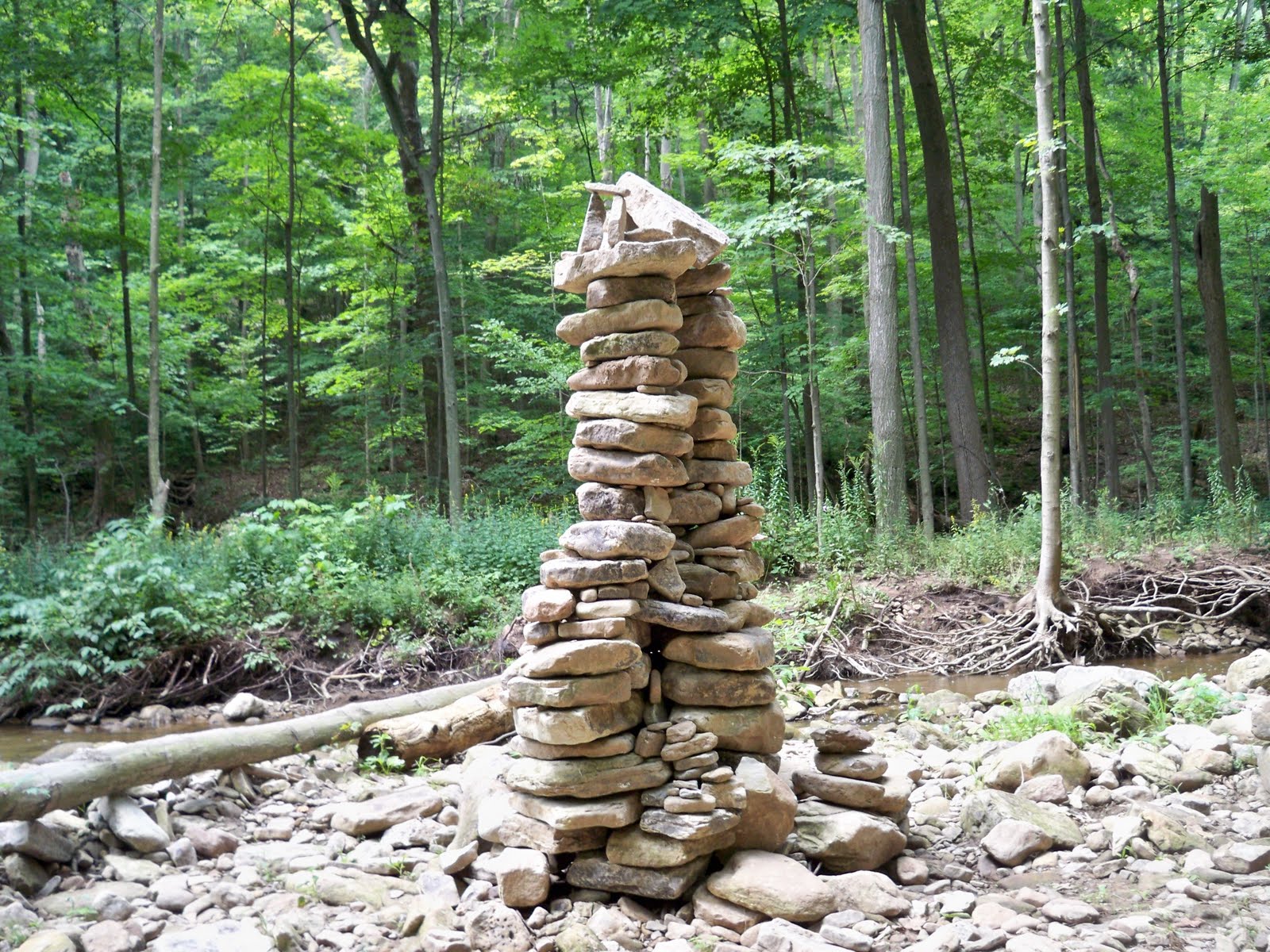
One of the things I do when I write a poem is to take a small image, something that impresses, that catches my attention with the emotional response it calls forth, and expand on it. Not always. Often the image that touches my perception can stand on its own and becomes a haiku. If it elicits one specific response, it will often become a tanka. But for a more expansive poem, the initial experience becomes the beginning of something else, something greater. Building a poem becomes an act reminiscent of constructing a cairn.

It’s not that the first impression has little or no intrinsic value. What happens is that I make connections to other events and emotions, and feel the need to bring them together. Often the first attempts will sound and feel over-sentimental, like a juvenile diary entry. Like building a cairn, shaping a poem takes time and effort.

Let me illustrate with an example – no, not the finished poem itself, but the layer-by-layer construction of it.
Sometime ago I was driving through wooded farmland on one of the four-lane divided highways toward sundown when I spotted some deer drinking from a creek several hundred meters away. Several factors impressed that sight in my mind: the evening light, the distance, the contrast of the natural (creek, deer, woods) and the constructed (highway, automobile, rushing humans), as well as my inability to stop and become a small part of that scene even though I wanted to do so.

Over the next few days that image would not leave me. It became connected to several other things. I was reminded of the creek on the farm where I grew up. I remembered also seeing and tracking deer in that area when I was young. The flowing water reminded me of a young lady I knew who loved to walk beside flowing water and stop to sit with her feet in the flowing water as a way to relax.

All these items came together in one unit, like different shaped stones in a cairn. Had the young lady, while sitting with feet in the running water of a creek, ever been surprised by deer coming to drink? She would be careful not to disturb them. Would she envy their freedom? I remembered that she now lived in a small city, married to a long-distance trucker. I wondered at the emotion she would feel, left alone so long so often. Would she go looking for flowing water to soothe her spirit? Would she remember the deer (the ones only my imagination provided)? Would she wonder if the deer remembered her?
So you see how the glimpse of deer drinking at sundown becomes a totally different thing, with the initial image remaining as a corner stone for the whole construct. My own emotional reactions, even my rational reaction, play only a secondary role to the imagined emotions of a young lady who is not part of the original.

And all that, as poetry, is as valid and real as deer beside a creek beside a highway.

Thursday, April 29, 2010

Rewriting: Self-Editing


One of the most valuable lessons I learned early in my writing career was that of setting myself apart from my work and seeing it as someone else might. Perhaps it is strange for a poet to say that an author of fiction talking about his own process first explained this to me. The concepts he expounded rang true, so true that I took the ideas to an older poet who I admired as a mentor. He acknowledged that the poet, perhaps even more so than any other writer, had to edit his work relentlessly and carefully. A poem should be concise and precise, a polished jewel. (At the time he was writing and publishing a lot of haiku, and had the explanations and examples from his own work at hand.)

Certainly, this included mundane things like spelling, punctuation, tense, and all the small irritants that could lower the quality of one’s work. But even more important than this was the use of words, of language.

He taught me many things. He taught me to plan a poem, to start with a definite idea of what I wanted to say and how to say it whether directly or through metaphor or simile. Cut all the words and phrases you don’t need, he would instruct. You don’t have to describe an orange as round. There are no square ones. Don’t get sidetracked by another idea that influences or modifies your original. If necessary, turn that into its own poem. Be aware of the influence of even the smallest word: ‘the’ apple refers to one specific apple; ‘an’ apple refers to any apple the reader may envision. Apple without any article suggests the essence of being apple-like and somewhat unreal.

Poems often try to convey ethereal, unsubstantial matters using concrete and physical images. Remember that it is easier and perhaps more effective to describe a boundary as a wall rather than a force field although it is probably neither. Use words that describe common, everyday experiences (and delete one of those words; ‘common’ and ‘everyday’ are almost identical) to hold the readers/listeners attention so that they too will reach your conclusion with you. Whatever you do, don’t pad your work – be it poem, story, article, resume – because it will ring untrue to a careful reader.

Spelling and grammar speak for themselves. If you don’t spell correctly, the words may not mean what you think; if you have no idea of the order and relationship among words, you can’t control what they do or say. It’s as simple as that.

Always edit; if necessary, rewrite. Very few poems, if any, leap perfect to the page from an imperfect mind.


Saturday, April 10, 2010

Crocuses

Early this spring, when we went through an unnatural warm spell, I stopped and talked to a neighbour who was clearing her yard of winter's debris. We talked about the weather's effect on tender spring plants and how an expected long frost and snowstorm could damage the crocuses already in bloom and the lilies-of-the-valley sprouting in her back yard. We agreed that such changes could also affect human behavior. She then confided that she was worried about her thirteen year old daughter. The young lady claimed to be very much in love with a young man and the mother felt she was too immature to feel so deeply, that she would be emotionally hurt. I had no advice to offer but I did write a tanka about the crocuses a few days later.


After some thought and careful consideration, the tanka turned out like this:

so early this spring
crocuses struggle
to bloom
how can I warn you
of impending frost?

Then I realised that this was not only a poem about a natural phenomenon, a thoughtful observation and its emotional impact, but also a metaphor for the situation the neighbour lady and I had talked about.

Her daughter, like a crocus, was doing her best to bloom as she was meant to; her mother thought the time was not 'ripe,' that it was too soon. She could see the possible difficulties, the hard frost looming in the near future, and felt inadequate to give her a warning she would heed.

Life and poetry, young girls and crocuses: oh, how they mingle!

Friday, February 12, 2010

Orchards, Poems, and Metaphor

While on a hike not long ago, I walked by an orchard; you know, fruit trees standing in rows. It is winter. They had been pruned and just stood there in the drab dead grass, no snow to give them some semblance of promise. Almost like old soldiers on a parade ground they stood, the same size, the same shape, all neat and waiting.

It made me think of apple orchards I have experienced, especially those when I was younger and just learning about the world. Made me think, too, about poems for some reason.

When I was a schoolboy, my friends and I would often make a little extra spending money in the early fall hiring out as apple pickers on weekends. There were two orchards in the area near us which were commercial enterprises. We loved the work: all the trees were the same size and nearly the same shape; the fruit was easy to pick from the ladders. Even if we were sent to pick the windfalls off the ground, the grass beneath the trees was kept short and we didn’t have to search. I remembered this and thought about the poems we studied at school, all the words in rows of the same length and the lines neatly arranged in stanzas like those orchards.


But then there was the collection of fruit trees at home. I suppose it could be classified as an orchard; the trees were placed in a couple of rows. The trees, however, were different sizes and shapes, different ages. They didn’t even produce the same kind of apple, and one was a cherry tree. In the spaces between the rows grew potatoes and vegetables. The gaps in between the trees were filled with berry canes and bushes, or open space. Thinking back on this orchard, I began to compare it with more modern poems: still in lines, but open and the spaces filled with other bits and pieces that still seem part of the poem. The variations make it more interesting but the lack of strict regimentation makes it seem wild. You have to get to know the space and the plants to find the essence of orchard, whereas the neatly arranged rows automatically say orchard.
Both produce fruit for human consumption. Both are arranged and cared for. The difference lies in manner, how the purpose is presented. That’s all up to the gardener.
The next time you come across what looks to you as a jumble of words and broken phrases, take a careful look. It might be an orchard.

Thursday, February 4, 2010

Rhythm and Rhyme: an Example

Every now and then I hammer away at the importance of rhythm and rhyme to poetry, the cadence and tone of language put to a special use. Although I don't usually post poetry, and almost never a new poem, I want to share this recent one (the last revision, an hour or so ago, escaped accompanied by a satisfied sigh) because of its use of these fundamentals. It's not a great poem, but it works for me as a poem and a prayer.

PRAYER FOR DIZZY

May in your new existence every whisper
that touches you be filled with a soft light
that carries in the rhythm of soothing murmur
the promises and mysteries of night.

May grass grow ever taller than your shoulder
and fall away from your approaching face
as you explore the clean expanse of meadow
and know that you belong in that new place.

May life again turn in familiar cycles
unfettered by the linear chains of days:
action and rest, hunger and satisfaction,
while all the words you hear are words of praise.

May simple dreams become their own fulfillment.
Rest on those cushions where St. Francis sat.
And when you sing out in the heavenly chorus,
let every angel know that you are cat.

Basic iambic pentameter. The alternating lines of each stanza (2 and 4) rhyme; the other lines end in feminine rhythm with an extra unstressed syllable. And those are the obvious devices; you can find more if you try.

The poem is not only a fitting memorial, it helps me deal with the loss.


Tuesday, January 5, 2010

Conversation Over Time

I recently held a conversation with a friend of mine, a conversation of sorts that was conducted via email. It was an unusual but nonetheless quite satisfying way to exchange ideas and comments.

Usually an exchange like that would take place face to face over a coffee or other beverage. Certainly it often takes place by way of the telephone. (I’m not familiar enough with instant messaging or texting to consider them.) I do know that it is an alternative to exchanging letters by post.

I personally prefer the email exchange, especially over the telephone conversation. It gives me, and the person on the other end of the “conversation,” time that does not seem available on the phone. On the phone a question or comment seems to demand an instant response; there is nothing more uncomfortable on the phone that silence. (“Are you there? Hello! Hello? Are you still there?”) I don’t know about others, but I like to think about what has been said to me, what and how I will respond. I don’t need an inordinate amount of time; ten or fifteen seconds will do to marshal my thoughts and words. However, for most others this seems a lifetime longer than they’re willing to give.

I have several acquaintances who carry this into their personal conversations. If you want to say anything, you have to interrupt them in the split second they use to take a breath. If you happen to refer to something they said much earlier, that point seems to have been forgotten in favor of what’s said “now.” The torrent is more important than the content. How can you exchange ideas and information without a dialogue?

So, I prefer email. I can think, order my thoughts, decide how to present them without being expected to do so instantly.

How does this connect to poetry? It has given me insight into how I write a poem. I think, order my thoughts, decide how to present them. And it all takes time. I can’t remember a poem that sprang fully formed into my consciousness; they have all needed some deliberate thought, shaping, other touches. In some ways, a poem becomes a conversation with myself.

That feels true, like a proper analogy. Inside my head I talk to myself. Some of those conversations are exciting, some are humdrum. Some drift away before they’re finished, some perhaps would have been better left unstarted.

And there is no telephone link between my heart and my head.


Tuesday, December 8, 2009

The Prose Poem

A number of years ago I won a prize for a prose poem. Since then I have been asked every now and then what the distinction is between poetic prose and a prose poem, and how you can tell the difference. I remind the questioner that (in modern times) the prose poem began as a poem that rebelled against the strictures of form in much the same way as free verse did. With both of these, the main difference from conventional poetry is in the presentation.

A prose poem should first of all be a poem; it should use language to do what poems do. It can, and should, use poetic devices that are not acceptable in simple prose. An extended metaphor may be the underlying conceit. The use of meter, of repetition, of internal rhyme - all the tools employed by the poet only enhance the prose poem.

Try taking a formal (shaped) poem and present it as prose: "Let me not to the marriage of true minds admit impediments. Love is not love which alters when it alteration finds, or bends with the remover to remove." Shakespeare's sonnet remains just that, no matter the presentation.

In my own work, I often develop a poem/idea in paragraph form, throwing in everything that I want to say and often twice. Then I look for places the piece can be broken into sections or stanzas. After that, I tackle each stanza separately, honing it down to what needs to be expressed in the best way I can express it, always with a sense of the whole. Only after that do I take a look at it and consider form. Would certain restrictions enhance the poem? If I present it as free verse, will the subtleties of rhythm be lost? Different questions for different presentations. Even going back to the prose poem is considered.

All that thought goes into the formation of each poem. That's why poetry is not simply inspiration, it is a learned and practised craft.


And by the way. If your free verse poem, when the line breaks are ignored, looks and sounds like a prose paragraph, it probably is. Try to write a poem using the tools inherent in language.

Sunday, November 22, 2009

"Cat" Poems


At a reading in Toronto the other evening, an acquaintance brought up what he referred to as my wonderful "cat" poem. I had difficulty remembering which poem he meant. Over the years I have written a number of poems about or featuring a cat. He was referring to one I had read to a small gathering in Gage Park several years before. I didn't have that one with me so I read a more recent one. The incident made me pause and consider.


Since I began to go out with my wife, long before we were married, we have always shared our home with one or more long-lived cats. One lived for nineteen years, one for over seventeen, and the current cat is going on sixteen and still quite healthy. So a cat, in one way or another, has always been there. And, since we write about what we know, about what touches us, it is no wonder that I have produced some "cat" poems.


I don't write little lyrical passages praising cats. Cats (for me) deserve much more. I tend to use one as a metaphor, sometimes for myself, my inner self, or for all humanity in its relationship to the natural world. I often use "catness" as a mirror to being human. Not in a fable-like way, nor do I endow a cat with human characteristics. Usually it's the other way around: I point out the "catness" inherent in people.


Cat poems have been good to me. They have won me prizes (cash and prestige) and brought me much satisfaction. Perhaps I'll leave you with one of my earlier ones.

SO LIKE A CAT

Your cat has particular manners, ways
developed for her own purposes. A voice
that leaps from articulate whisper to
bone-scraping howl in less than a second.
Hiding places that will change just as fast
as you can discover them. She has need
for constant warmth; on cold days she cocoons
among blankets, in the sun she stretches
out full length on her back.
----------------------And you have wiles
in common with your cat. Your body too
stretches to capture my warmth, slips away
from cool indifference. The place you hide
changes with the moon's phases. Tentative,
my hand reaches out for your approval.


Sunday, October 25, 2009

Young Writers

This past Friday evening the annual "Power of the Pen" Awards for young writers were held again; again, I had had the honour of judging the poetry submitted by seventeen year olds. Much of the event was the same, but let me dwell on a few things that were different.

Previously I mentioned that I had greater difficulty choosing the top two (and their order) than in years before. Speaking to other judges, I found that I was not alone. Therefore, I think it fair to say that the overall quality of writing entered was better than before. I didn't feel so awkward about suddenly giving out honourable mentions.

The overall awards given out by the Hamilton Association for the Advancement of Literature, Science and Art, which seem usually to go to older and more mature writers went to relatively young writers this year. The short fiction award went to a fifteen year old; the poetry award went to a thirteen year old. After reading the award winning entries, I concurred with the judges. Just as an aside, the second place overall for poetry was the one I had selected for second prize in my age category.

That brings me to the one disheartening part I feel I must mention. When I opened the book of winning stories and poems, I didn't recognize at first the poem I had selected as first in its category. Why did I choose this one over the #2 which seemed so much more direct and poetic? Then, nosing around in the presentation envelope I saw a copy of the original work. Part of it (a part just as important as the rhythm and the images used) was the placement of words and phrases on the page. In the publication all that was lost, all the intricate possible relations between words and images, simply by centering each line. I hope the prize satisfied the author; the layout of its publication certainly dismayed me.

Anyway, enough vexation to make me want to stop judging if I can't control the quality of final publication. But then, would someone else have seen the significance of the layout, and rewarded it? That's enough to keep me in the game. I would have liked to congratulate the young poet in person, but that didn't happen. And so it goes.


Tuesday, September 29, 2009

Poetry Workshop

I just want to express a couple of thoughts on workshops, poetry workshops in particular. You know, those meetings whose main purpose is to provide a forum for a poet to present his work before an audience of his peers, and receive considered feedback rather than instant reaction.

We're not considering closed groups here. Those also have a role to play; they become intimate as the members grow together. This is about open groups, no membership required.

There are several things you should be aware of when participating. Because you approach the group for a stated purpose, to receive critical assistance, don't bring a poem which you don't believe you should change, that you think is so good that you just want to show what you can do. Your friends and peers may well cut it to ribbons to show you how they would improve it. If you don't think a poem needs improvement, don't bring it. The group is not there to heap praise; don't expect it.

Also consider this. Since it is not a closed group but open to anyone expressing an interest, making a presentation to such an audience can be considered a form of publication, especially if hard copies of your work are distributed. You have very little control over what happens to those copies in the hands of your "public."

Just a few things to consider. Remember, when you ask a friend to become a critic he also becomes an antagonist. Usually the frienship remains unharmed.

Monday, September 21, 2009

The Inherent Rhythm of Language

The other day a lady friend of mine brought a new poem to a workshop we both attend. Her poem surprised me because it was not in her usual style, longer lines with almost no sense of a cohesive rhythm. This time she had done something completely different.

Not only were the lines short, almost all the same length, but she had marked (and left those marks on the page inadvertently) each line with the number of syllables she had used. Most lines were four syllables, with the occasional use of five or three.


Now I'm not one to advocate counting syllables in poetry instead of using and playing with established rhythms, but in this case it worked. It helped that she used a four syllable line, most usually of two words; in English it seems difficult to put four syllables together without ending up with an iambic dimeter or a close variation thereof with a trochee or spondee. There seems to be no way a unit of four syllables can stand without at least one, and more comfortably two stresses. And this becomes a natural iambic rhythm, pleasing to the ear and to the mind.

This started me reflecting on the natural rhythms of languages, especially Indo-European languages with which I'm familiar. For me, iambic feels so right for English, (much more so than for Old English and even Middle English.) daDUM daDUM daDUM daDUM seems to roll so fluently from the throat. On the other hand, German, Dutch, etc. seem to come into being as a stream of trochees: DUMda DUMda DUMda DUMda.
French, again, has another and separate rhythm pattern expressed (to my ear) in anapests, dadaDUM dadaDUM dadaDUM dadaDUM (see Gilles Vigneault's "Mon pays ce n'est pas un pays c'est l'hiver.") The foot my ear finds most often in the Italian language, and I believe also in Spanish, is amphibrachic, with the stress on the penultimate of a three syllable foot, daDUMda daDUMda daDUMda daDUMda.


Ah, marvel at the subtle intricacies of the rhythms of language! Truly it is a reflection of the music of the spheres, the sound of all things working and singing together!

Thursday, August 27, 2009

Shaping a Poem


I've just finished judging the entries for the seventeen-year-olds in the Power of the Pen contest run by the public library. The choice this year was more challenging than last; for the first time I gave out several Honourable Mentions, something I had never needed to do before. There were five poems vying for two places. I gave the three that didn't win or place those honourable mentions.

The entries became a goad to write about shape in poetry, as it differs from form. Most of the entries were centered rather than left margin justified as is the usual manner. Centering, especially three or four word sentences for no specific effect, becomes very annoying. Almost as bad is the "concrete" poem. We all know them: the love poem shaped like a heart, the angel poem shaped like wings, the one about trees taking the form of a tree.

But sometimes a poem takes on a shape of its own, something internal that is part of its manner of expression. It may indent different lines from the margin for emphasis of those lines. Different margins for differing length of line may be used. The first word of a line may be placed in relationship to a word or phrase in the previous line, stressing how it expands or defines that word or phrase. The reasons go on.

Here is an example of its use by e. e. cummings.

The main reason for these words now is because the poem I chose as winner in its category for the Power of the Pen uses such placement of lines on the page and uses it well. By this means it emphasises both shape and meaning of the poem.
I pray it doesn't happen again. A different librarian is in charge this time and I hope she can see the rationale behind keeping the format, that the poem as it appears is more than a string of words.
Like a cubist painting is more than lines and colours.


Tuesday, July 14, 2009

A Different Task


I have taken upon myself a task that is becoming quite a challenging project.

I'm involved in the activities of a group promoting Hamilton as the "Waterfall Capital of the World," the city with more waterfalls within its boundaries than any other. Some of the earlier background research found a poem concerned with a legend attached to one of the more spectacular waterfalls. In a poem written in about 1900 and called Na-Go-She-Onong, a J. L. Lewis tells the story of a native princess who died with her lover in a leap over Webster's Falls.
The story is straightforward, a tale of love and jealousy that ends in tragedy. However, the original poem consists of 216 lines, 27 stanzas of eight lines each. Since I'm a poet and most of the others photographers, I was challenged to turn it into something that could be read or recited at gatherings without boring the audience with length and detail. I accepted that challenge.

Because of the non-literary nature of my primary audience, I have decided to rewrite it in "poetry" they know, structured with rhyme and rhythm. I am approaching it by using a ballad form. The problem now is how much of the narrative can be left out, only hinted at; how much of the description is necessary.

So far I have a framework in mind and the first several stanzas have been written as tetrameter quatrains. Now to touch on the important points of the "story" and keep it all simple and succinct.
Honour the lady, the legend, and the place!

Monday, December 22, 2008

Show or Tell

I'm somewhat confused by what I did here the other day. I posted a haiku that seemed illustrative of a photo I had taken. I felt so proud of joining illustrations with haiku that I did it again. And again. And again.

Then the question of show/tell rose again and I began to doubt my actions. Do the illustrations add to the poems or do they invalidate the reader's vision and impose mine? The Japanese masters sometimes accompanied haiku with brush stroke ink drawings; suggestive material rather than the graphic items used with mine. The question again, do the photographs tell?

Sometimes it seems necessary to connect a graphic with a poem. A friend told me how he and his wife, a painter, would sometimes picnic at out-of-the-way places; afterward she would paint and he would compose poems. Many times, he said, the painting and the poem seemed to belong together; they were expressions of the same experience embodied in different media.

I know what he meant. It happens for me, sometimes, when I'm moved to write a response to a work of art. If the artwork touches me, resonates with me, satisfying things can happen. Often the two seem to work better in each other's presence: what would this poem be without the sculpture?


INNOCENCE


Undisturbed
and filled with self-assurance,
she combs her hair.


She sits amorphous
with the innocent guise of a child.
A woman’s shape is still obscured
in the thickness of her waist,
the solidity of her unformed hips,
the soft fat on her rib cage.


Affirmation of femininity
is already evident in the energies
flowing through arms and hair,
the slow twist of the torso.
There is grace in the curve of her neck;
in her thighs, the promise of power.


Oh, could we but capture
that timeless innocence forever,
hold it in bronze.


(both poem and image are copyrighted to the respective artists)


Well, I guess that answers no question. Maybe there is no answer. Maybe the question is often irrelevant.

It just goes to show ...

Friday, December 19, 2008

Show ... Tell ...

A friend trying to craft poetry came to me and expressed his frustration. "Everyone says to me," he complained, "show, don't tell. But if I show people, don't I tell? If I tell people, don't I also show? So explain to me: what's it all about then?"

I did my best, using this analogy.


You obtain a wonderful painting that moves you so much that you want to share it with all your friends. How are you going to do this? You could write a description of it; list the colours used, the figures portrayed; you might even remark on the use of light, proportion. You create a description as close to what you see as you possibly can and send it to your friends. Some close friends you might even gather together, and present your material in a lecture, with slides. Everyone knows, or should, as much about the painting as you now. You have shared it. You made it a point to TELL them all about it.


Now suppose you hang that painting on a living room wall, by itself without distractions, and illuminate it with a source that highlights it. You invite everyone to see your painting, then retire to the kitchen to supervise the refreshments. The visitors are left to themselves to experience or study your painting according to their own interpretations, take in the details that matter to them, and also keep your opinions out of their enjoyment. You simply SHOW it to them.


And that is how a poem should work. It should start with your personal reaction. If all you want to do is present a series of facts with your own impressions, write an op ed piece for the newspaper. If you want to use language and its wondrous intricacies to elicit a similar response in your reader/listener, untainted by your explanation, you might be able to present it as a poem.


A poem is like a painting in that respect. It uses different materials, but exists to elicit that individual response And not necessarily the one you expect.

Friday, November 28, 2008

Arts Hamilton Literary Awards

Arts Hamilton held their literary awards evening Wednesday night. Before the presentations we were given, instead of the usual speech, a video display of the plans for a permanent "Art Walk" along King William St. (See CITY and ARTS 2 below.)

My recent book In Times of Changing Seasons was nominated for poetry book of the year. It lost. The winner was A Bundle of Life by Joanna Lawson. Irony? It was published by Serengeti Press, and I provided any needed editorial work. If someone else had to win, no better choice.

I did win for one poem I submitted that had been published in the anthology Cats, Cats, Cats, and More Cats, a poem called "Sandburg's Fog" written in reply to Carl Sandburg' famous imagist poem.

Fog

The fog comes
on little cat feet.

It sits looking
over harbor and city
on silent haunches
and then moves on.


My poem was written as a "performance piece," and as such had been performed at many venues over the past 12 years or so but hadn't been available in hard copy until I was asked for poems for an anthology about cats. It was very disconcerting to hear the presenter read it as if it was a group of words on paper; it is so much more!

Anyway, here is the poem.


SANDBURG’S FOG
(The fog comes on little cat feet...)

Sandburg, your poem
its simplicity and quiet image
may work in your mind
in your city
but not in mine.

My black cat has oversized feet.
He never silently slips
into a room but hurls himself
under and over the furniture
with the force and roar
of a tornado.

Up and down stairs he thunders.
You keep an eye out for flying glass,
suspect the tremors of earthquakes.

And fog never sits
over this harbour and city.
It rolls, swirls, breaks
against the mountainside
and rips into its own belly with anger.

A foggy morning here, Carl,
is seldom less than full-scale war.

So much depends upon your city
and your cat’s feet.


And my older bigfoot cat: