Showing posts with label inspiration. Show all posts

Wednesday, August 25, 2010

Expanding Experience

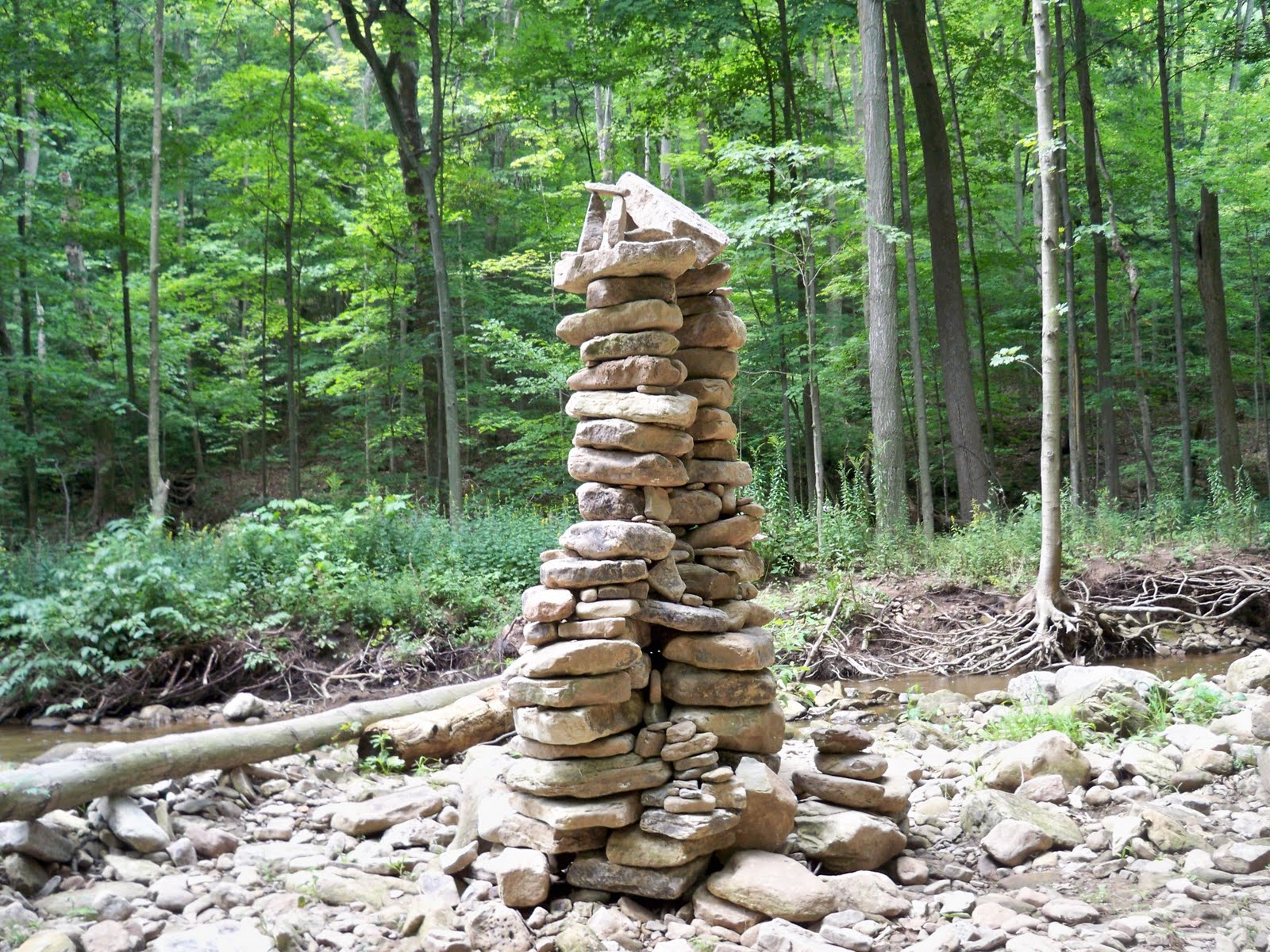
One of the things I do when I write a poem is to take a small image, something that impresses, that catches my attention with the emotional response it calls forth, and expand on it. Not always. Often the image that touches my perception can stand on its own and becomes a haiku. If it elicits one specific response, it will often become a tanka. But for a more expansive poem, the initial experience becomes the beginning of something else, something greater. Building a poem becomes an act reminiscent of constructing a cairn.

It’s not that the first impression has little or no intrinsic value. What happens is that I make connections to other events and emotions, and feel the need to bring them together. Often the first attempts will sound and feel over-sentimental, like a juvenile diary entry. Like building a cairn, shaping a poem takes time and effort.

Let me illustrate with an example – no, not the finished poem itself, but the layer-by-layer construction of it.
Sometime ago I was driving through wooded farmland on one of the four-lane divided highways toward sundown when I spotted some deer drinking from a creek several hundred meters away. Several factors impressed that sight in my mind: the evening light, the distance, the contrast of the natural (creek, deer, woods) and the constructed (highway, automobile, rushing humans), as well as my inability to stop and become a small part of that scene even though I wanted to do so.

Over the next few days that image would not leave me. It became connected to several other things. I was reminded of the creek on the farm where I grew up. I remembered also seeing and tracking deer in that area when I was young. The flowing water reminded me of a young lady I knew who loved to walk beside flowing water and stop to sit with her feet in the flowing water as a way to relax.

All these items came together in one unit, like different shaped stones in a cairn. Had the young lady, while sitting with feet in the running water of a creek, ever been surprised by deer coming to drink? She would be careful not to disturb them. Would she envy their freedom? I remembered that she now lived in a small city, married to a long-distance trucker. I wondered at the emotion she would feel, left alone so long so often. Would she go looking for flowing water to soothe her spirit? Would she remember the deer (the ones only my imagination provided)? Would she wonder if the deer remembered her?
So you see how the glimpse of deer drinking at sundown becomes a totally different thing, with the initial image remaining as a corner stone for the whole construct. My own emotional reactions, even my rational reaction, play only a secondary role to the imagined emotions of a young lady who is not part of the original.

And all that, as poetry, is as valid and real as deer beside a creek beside a highway.

Saturday, August 14, 2010

Celebrating with the Word

Usually in present North American culture, we celebrate events and times by music and motion — song and dance. A wedding celebration naturally culminates in a dance; funerals and memorial services move from song to hymn. It was different then, and quite uplifting, to attend a literary event of celebration. Last night, as part of commemorating 175 years of existence in Hamilton, Stewart Memorial Church began their homecoming weekend with a gala of presentations of a literary nature.

The church was founded as part of the African Methodist Episcopal denomination and remains a predominantly Black congregation. Perhaps because of the ties to African slaves as well as more recent Caribbean migrations, this celebration by word was offered to the congregation and the public. Whatever the reasoning behind it, the concept worked.

It worked for several reasons. The writing presented was a mixture of both substance and style. There were presentations, authors reading excerpts from their books, that were historical and accurately researched; there were poets spinning words and images only grounded in experience; there were storytellers who took the factual to build stories that tugged at the spiritual and emotional parts of us. But the most notable aspect of the church’s literary evening of celebration was that it did not focus on the church, its history, its well-known members past and present. Instead it presented the culture of all the peoples it encompasses.

Nor did the words of celebration only recall the past. The past was dealt with in story and history; too, there were poems and stories of the present. From the poetry especially, joy and hope for the imagination. Commemoration of yesterday, the solidarity of today, the brightness of tomorrow: all were interwoven into the celebration. And rightly so.

Today the celebration continues, this time with music and song. Tomorrow a more solemn service with a guest preacher.

And it began with the words. Sound familiar? “In the beginning was the Word … ” (John 1:1)


Sunday, May 30, 2010

Passing It On


The other evening a friend and I were having a discussion about the artist in the community, not the worth and purpose of the artists so much as how they fit into everyday life. He’s a musician and said that the most satisfaction he gets out of public performance is not based in praise or applause but the sense that some of the audience had been “touched.” He explained that it was an awareness of sorts that what he had been doing had let someone reach into himself to find a creative spark; it need not necessarily apply to music but any way of creating something other. The artist’s role in the community, he suggested, was to pass on the knowledge that all have a talent and should display it to the best of our ability. It doesn’t matter what, just that each one create.

I told him I could understand that about musicians and their instruments in a public performance, even actors although they hid their real selves behind a character. A visual artist is exposed through the works hanging in public galleries, film makers etc. in theatres. But how do you make that work with writing, with the literary arts? “You perform words in public,” he replied. “You do readings not to simply advertise yourself and your work, however valid that purpose may be. You have to show that creating is worthwhile, that it is delighting and satisfying.”

I remember once talking of poetry to a small group of eight to ten year old children. I was explaining rhyme and the ways different words can sound not the same but alike. I would give a simple word like “cat” and ask several of the youngsters, one by one, to give me a word that sounds like it, that rhymes with it. They grasped the concept easily enough and I was ready to go on to rhyming phrases and lines when one girl’s face lit up. Unasked she began to speak out many rhymes for different words, with an ecstatic look on her face as if she had discovered something magical. Deep within her the repetition of sounds had lit a spark of joyful creativity. I don’t know if she ever went on to write or use language in other ways. I felt like a master who had just gained an apprentice. The essence of the poet had been passed on.

And then at PoeMagic, his reading/performance series, Klyde Broox touched on the same thing. Talking about the reasoning behind PoeMagic, Klyde spoke of developing a community, a gathering in time and space where poets and spoken word artists could be together and share their creativity, where the more mature artists could fan that spark in those beginning to find a voice. Schools for artist, writing courses, and such only teach basics and methods. Creativity itself can not be taught. It must be developed and the best way to ensure such development in the younger writers is to provide chances for their works to be heard and seen. So it was his intention to form such a venue where all levels of writers of any creed, colour, social status, or whatever may seem to divide us were free to grab the spark and fire up their creativity.

And I agree. Poetry readings should not be simple showcases for one person’s work but reach to build awareness, an awareness that poets can be serious and fun, even seriously funny. I don’t remember ever setting up a reading series just for development of an artistic community but the concept is intriguing. I may be a little too old to take up such a task myself, but I will support to the fullest anyone who can and will.

So if you are just beginning to write, even if not seriously, don’t judge yourself by what publication credits you may achieve. Find a writer or group you admire and write toward their approval. Most are happy to pass on their outlooks and enthusiasm.


Friday, May 7, 2010

Linked Art

Personally I’m not one for “writing exercises,” those little ideas that are supposed to enhance style or make creative juices flow. However, recently a fellow writer approached me and asked me to set him a task; he was bored and wanted to write. He just had no idea what to write about or how to start.

I had recently come into possession of a small book authored by two poets. Rather than separate sections or groupings, each poem was written in response to one of the other’s existing poems. That way, if each had sent the other ten poems the book would end up with forty, twenty originals and twenty responses. There was no specified manner to respond; it could be to the subject, to an image, an emotional or rational response, no restriction.
I have always liked the concept of linking things, works of art especially, together to form something separate and perhaps greater. For a number of years now I have taken part in a local art celebration where poets are asked to respond to a piece of visual art in poetry. The poem and the art it responds to are then displayed together in storefront windows for a week.

I have written in response to paintings, drawings, and such but also to pieces of sculpture. Some of the most challenging work was in response to crafts: glass boxes, a jar, pieces of jewelry, fabric. I find the visceral response to such things more perplexing to explain even in non-poetic concepts. The intriguing thing here is to be able to establish a link, sometimes obvious, sometimes a little obscureThe Japanese have a tradition of renga, linked verse. Over the centuries the format (subject of certain verses, segmentation of the whole, and other “rules”) became strictly observed. I understand that the modern practice, in the last half-century or so, has moved away from that meticulousness and is more open and flowing without losing spirit and purpose. It reminds me of a piece of linked or collaborative art I was involved with in the late 1970s that was called “Peace Renga.” Writers, musicians, and other artists were invited to submit work on the theme of world peace. Many, if not all, were linked together and performed several times in different venues – music was played, prose and poetry read, paintings and photographs projected on a screen for a very moving presentation. I was proud to provide a small part of the whole, to be part of a community declaration in art.

I find that most of my writing is in response to something external rather than having something burning inside demanding expression. My response is a way to better understand, to make sense of the world around me to myself and share that understanding and viewpoint with others. In this way responding to another’s response creates for me a deeper level of seeing, of knowing.But back to my friend with the demand for a writing exercise. I sent him two lines of poetry with no hint as to title or subject matter. I asked him to respond with the same, no more than three lines if he must, linking it to my original as he saw fit with no explanation needed. That was a couple of days ago; he hasn’t replied yet. If it doesn’t get him in a writing mood, at least it has served as subject for my little meditation.

Thursday, April 15, 2010

Morning Light

They’re here again, those mornings with soft light breaking at dawn, hanging on for endless moments before burning its way into the day. I have always loved to sit out and watch the sun rise, more so than to watch it set. When I lived as a night owl I would stay up to watch a sunrise before going to bed; when I worked shifts I missed being available for either the rising or the setting sun. Such magic must be observed. There are enough days in a life without it.
The light available before sunrise seems to grow as if it were alive. Not only does it expand to fill space, it often seems to diffuse and enter into all the solid matter and for a short time gives the material world a spiritual essence. This is what makes the music of classical Indian music, especially the ragas written for this time of day, so moving for me. I have gotten into the habit of spending the time between the first coffee and a solid breakfast in meditation and contemplation. Once I used to do so with music playing, ragas or streams of Celtic instrumentations. Nowadays, unless a great number of irritations are present, I prefer the silence and the natural rhythms of birds and winds, and even the hum of traffic may blend in.

And then there’s the poetry. Since medieval times songs and words have been written for and about this time of day. Even in today’s English verse a lyrical poem about dawn, whether in praise or about love, with joy or pain or contemplation, is known as an aubade (from the French and Provençal). At times I write a poem directly influenced by one specific sunrise, but recently I was nosing around some of my earlier work, both published and unpublished, and marveled at how often the sunrise in one way or another influenced my poetry. Even without specific mention of the time of day, I could feel the serene effect through the images used. I had been writing aubades even before I understood what they were.

I continue to write poems under the influence of the rising sun. Sometimes they remain compact as haiku or tanka. Sometimes the imagery becomes incorporated in something other. And sometimes it becomes a complete lyrical expression of praise and contentment in and of itself.

As a poet and as a human being, I remain entranced by the rising sun. No wonder world religions use the symbol with great power.

Monday, April 12, 2010

Hiking Over Trails of Poetry

I belong to a group that does a fair amount of hiking together. The hikes are usually scouted beforehand and rated as to the degree of difficulty involved. We don’t include (in that rating) areas with paved surfaces often specifically designated for walking, roller blading, or cycling. Such are simply walks or strolls. Hikes take place on natural surfaces.
Now there are a number of different terrains and types of trails that we encounter and rate. There is the well-traveled route, often a rail trail or other such path with more or less easy access and level progress, the kind comfortable enough to take a child in a wagon or stroller with little effort. Much of the journey can be covered walking abreast with a companion. Any trail consisting of mainly such is considered “easy.”

A “moderate” hike usually takes place in places where there are hills and/or ravines involved. Progress is often single file, the surface can be uneven and wind though trees and around rock; care must be taken with footing in places. It is excellent exercise and soothes the mind.

A “difficult” hike is one in which steep climbs or scrambles are likely to be encountered. Many of the local ones involve creek beds and deep ravines. There’s a saying that for one of these hikes you need all four limbs to get around. They can provide an exhilarating challenge, a change from the usual.
Then, of course, there are extreme hikes that require special knowledge, skills, and equipment. Activities such as climbing frozen waterfalls or traversing rock faces are not ones we would consider.


So what has all this to do with poetry? While hiking images suggesting poems will often come to me; again while working on a poem a sudden memory of something observed or experienced during a hike may lend to a poem’s clarity. And stepping aside, observing people’s involvement with poetry is much like identifying the levels of a hike.

The stroll or walk on prepared surfaces can be seen as the everyday experience of poetry, the stuff we encounter in greeting cards and such. Nice, but no challenge whatsoever.

The “easy” hike is one for which you prepare, leave your daily comings and goings. It is much like picking up a volume of poetry where you know what to expect but reading that is not part of your daily life. It can be a gentle, controlled excursion through a landscape not quite familiar but not threatening.

We can then compare the “moderate” hike to exploring poems or poetry that presents a challenge to us in its use of language, of form or lack thereof, of not immediately evident meaning. This type of poetry involves the mind as hiking terrain would the body.


The “difficult” poetry hike would be through material you might not consider poems. Even many readers and lovers of poetry have difficulty accepting such presentations as prose poetry, dub or spoken word. They seem to follow a different set of rules that seem to disconnect them for what we might consider the “norm” and thus engage all our attention and effort to make our way through. And here too, the journey can be one of discovery and exhilaration.

Even in poetry the “extreme” can be present, poetry that uses foreign or classical languages, that refers to obscure events or mythologies to make its way to meanings that still never seem clear.

And always it’s good to remember: one person’s easy is another person’s moderate. Difficulty in poetry as in hiking is subjective. What I suggest is that everyone should challenge themselves, in hiking and in reading poetry.

Friday, February 12, 2010

Orchards, Poems, and Metaphor

While on a hike not long ago, I walked by an orchard; you know, fruit trees standing in rows. It is winter. They had been pruned and just stood there in the drab dead grass, no snow to give them some semblance of promise. Almost like old soldiers on a parade ground they stood, the same size, the same shape, all neat and waiting.

It made me think of apple orchards I have experienced, especially those when I was younger and just learning about the world. Made me think, too, about poems for some reason.

When I was a schoolboy, my friends and I would often make a little extra spending money in the early fall hiring out as apple pickers on weekends. There were two orchards in the area near us which were commercial enterprises. We loved the work: all the trees were the same size and nearly the same shape; the fruit was easy to pick from the ladders. Even if we were sent to pick the windfalls off the ground, the grass beneath the trees was kept short and we didn’t have to search. I remembered this and thought about the poems we studied at school, all the words in rows of the same length and the lines neatly arranged in stanzas like those orchards.


But then there was the collection of fruit trees at home. I suppose it could be classified as an orchard; the trees were placed in a couple of rows. The trees, however, were different sizes and shapes, different ages. They didn’t even produce the same kind of apple, and one was a cherry tree. In the spaces between the rows grew potatoes and vegetables. The gaps in between the trees were filled with berry canes and bushes, or open space. Thinking back on this orchard, I began to compare it with more modern poems: still in lines, but open and the spaces filled with other bits and pieces that still seem part of the poem. The variations make it more interesting but the lack of strict regimentation makes it seem wild. You have to get to know the space and the plants to find the essence of orchard, whereas the neatly arranged rows automatically say orchard.
Both produce fruit for human consumption. Both are arranged and cared for. The difference lies in manner, how the purpose is presented. That’s all up to the gardener.
The next time you come across what looks to you as a jumble of words and broken phrases, take a careful look. It might be an orchard.

Monday, February 8, 2010

A Man of Words

When is a poet more than a poet? When he's Mutabaruka.

This past Sunday, for the beginning of Black History Month, the Afro-Canadian Caribbean Association brought the renowned master of dub from Jamaica to Hamilton for a celebratory performance. I can't speak for the other people there, but he certainly exceeded my expectations.

The legendary poet delivered the poems as expected, in the manner expected: unaccompanied lines of rhyme over a perceptible reggae rhythm. Poems dealing with the socio-political and -economic subjects dub is known for. Poems of anger and rebellion, of struggle for freedom and dignity. But with Mutabaruka, much happened between and around the poems.

There was, of course, his Rasta persona - with colorful robes and bare feet and tucked-away dreadlocks. But he is a man of words, of language, and the way he used language was riveting. Between poems, no, more like literate segues into and out of the poems, came stories that made you laugh. And just when you thought the man had transformed into a stand-up comedian, he would shift into an oratorical mode, making you realize the story was not a joke just for laughs. Whether he delivered the words in lightly accented English or spoke in the heaviest patois, the stories, the exhortations, the poems, all flowed together in one seamless weave.

And the audience, black or white or in between, loved it and expressed themselves with vocal response and applause. It was only fitting that Mutabaruka was the final item on the program. After him, we had little mind or breath left to appreciate anyone or anything else.

The man is so much more than a poet. He has a wonderful touch as a storyteller, drawing his audience in with his expression. And the voice? I could hear the old time preachers and politicians ringing out.

The whole experience? Mesmerizing. I'm still astonished and a little envious. If only I could deliver my words with half that power and conviction . . .


Tuesday, January 26, 2010

A Source of Inspiration

Some of the light has gone from my life. A source of inspiration, direct or indirect, for my poetry has been extinguished. For his own well-being and my responsibility for it, my cat Dizzy was helped to his final sleep.

So. An old man commiserates about his pet cat. Maudlin, you say? Perhaps so. But this cat among the many I have known was special, special to me and my poetry. Here I want to talk about him not as a cat, but as poetic inspiration.

Those who know me and my work know that one of the themes running through my poetry is the interconnectedness between the human and the natural. Often I will use animals and their behaviors to reflect that of people. Don't take me wrong, it's not anthropomorphic; they just become symbolic of human strengths and weaknesses.

Many of the animals I use are those I observe. The animals I know best become the most important to my poetry. Dizzy was one, perhaps the most important one. He was part of the mindset behind "Premises for a New Animal Husbandry" that won the GRAIN prize for prose poem in 1995. ("Cats are not animals.") He was the subject of my poem "Sandburg's Fog" which won several prizes. ("My black cat has oversized feet.") He inspired several more directly.

And now he's gone. Can I say I am partially blinded? So much of my view of life was based on seeing it from outside my self, and Dizzy was much of this "outside" space. I intend to get another cat. The house is too empty; there is no one to talk to, to curse at in foreign languages. No one but myself to hear my poems spoken. I need another non-critical and honest companion like Diz.

Another cat will probably not be like Dizzy; I can't expect that. All I can hope is that I can again establish a bond that is favorable to what I write.

We write what we know and love.

Saturday, January 16, 2010

A Poem Should . . .

A few days ago I was reading through an anthology, one of those where somebody has put together a number of poems (this time it was one hundred) without any theme or other formal structure. It could have been titled "my favourite poems of all time" but wasn't. Most of the poems were from England and North America (including Canada) in the nineteenth and twentieth centuries.

Nothing wrong with that, only it did seem a needless waste of energy and resources. But even in all its glorious blandness, it made me stop and ask myself, "What is it about a poem that would make me take such notice of it that I would go back to it time and time again?" Some time spent ruminating and reading, checking my personal "favourites," led to the conclusions I'm setting down here.

Without analyzing the poems into destruction, I discovered some common threads, characteristics of poems that made them appealing to me. I found I could distill them down to three concepts.

One, the poem must transmit or transfer an emotion. If a poem deals with feelings I have never felt or don't find important, it doesn't touch me, doesn't work for me. This doesn't make it a bad poem; it's just something I don't go back to. Take for instance the difference between a love poem and a poem about love; for me a love poem is a sharing, an experience "inside," while a poem about love leaves it all sitting in space between the author and reader, "outside."

Two, the poem should, in its way, be rational. It should catch my mind long enough to force me to think about its subject, what it is trying to say or convey. It should not be like a lightning bolt, all instant flash and nothing left behind, but more like fine whiskey of the brain, with a growing glow and an insistent warmth that continues long afterwards.

Three, the poem should make me wonder, should expose a little of the everyday miraculous that takes special effort to bring to my awareness. This is the "art" for which the craft is practiced; this is the holiness of creation - the ability of words to extend me beyond my ordinary self.

So that's how a poem works for me. It should make me feel; make me think; make me wonder. And not all to the same degree. A poem that makes me wonder may not seem as rational or emotion-based as others; the same goes for any of the three concepts. I'm just trying to say that those three must be present in some combination to work as poetry. To work for me.


Sunday, December 20, 2009

The Olympic Flame as Metaphor


Yesterday evening the Olympic torch, carrying the flame lit using a concave mirror at Mount Olympus in Greece and heading to the 2010 Winter Olympic Games at Vancouver, came to Hamilton as part of the relay that brought the symbolic spirit of those Games to many of the communities throughout the land. (Whew, what a mouthful of words that is!) Although it was cold and dark, I decided to go and take part in the festivities. Just to be able to say I did, you know. Like dipping your foot in the ocean when you're on the coast. And it was taking place only a few blocks from my home.

Several thousand enthusiastic supporters had gathered. There was music by several local artists. There was another creating a painting on stage. A troupe of acrobats cavorted. Drummers drummed. There was video when the stage wasn't monitored. And always the words from the sponsors and their displays and their hand outs.

The flame arrived as and when it was supposed to. Stirring speeches were made. Et cetera, et cetera, et cetera.

So what's it all about? Symbol and metaphor, the stuff of poetry. There was no poetry there last night even though the event (to my mind) cried out for something to embody that symbol, to use it in its full metaphorical context. I wondered if that had ever been done; someone must have put their mind to it but, unlike the record books, was any trace left?

Later at home I researched my question. (Alright, I googled "Olympic poetry.") I discovered some interesting facts. The early Olympic games in Greece BCE was a combination of several regional contests; one of those had included competitions of poetry and rhetoric. Imagine, barrel-chested men roaring poetry to an audience or to each other! And then I discovered a proposal to reinstate this at the London Games in 2012 with a poetry slam! Hmmmmm.

On a more realistic note, the Australian poet Mark O'Connor had written a series of poems about the Sydney Games as they were happening. What's more, he was supported with a grant by the Aussie government; the IOC, which he did approach, wanted nothing to do with an "official" poet, a sort of Sport Poet Laureate." Among the poems Mark created are two dealing with the torch. One is called "Torch Running," about the relay as it passes from place to place. The other is titled "The Olympic Torch As Metaphor."

That takes the necessity out of my hands! Only goes to show.

Sunday, November 22, 2009

"Cat" Poems


At a reading in Toronto the other evening, an acquaintance brought up what he referred to as my wonderful "cat" poem. I had difficulty remembering which poem he meant. Over the years I have written a number of poems about or featuring a cat. He was referring to one I had read to a small gathering in Gage Park several years before. I didn't have that one with me so I read a more recent one. The incident made me pause and consider.


Since I began to go out with my wife, long before we were married, we have always shared our home with one or more long-lived cats. One lived for nineteen years, one for over seventeen, and the current cat is going on sixteen and still quite healthy. So a cat, in one way or another, has always been there. And, since we write about what we know, about what touches us, it is no wonder that I have produced some "cat" poems.


I don't write little lyrical passages praising cats. Cats (for me) deserve much more. I tend to use one as a metaphor, sometimes for myself, my inner self, or for all humanity in its relationship to the natural world. I often use "catness" as a mirror to being human. Not in a fable-like way, nor do I endow a cat with human characteristics. Usually it's the other way around: I point out the "catness" inherent in people.


Cat poems have been good to me. They have won me prizes (cash and prestige) and brought me much satisfaction. Perhaps I'll leave you with one of my earlier ones.

SO LIKE A CAT

Your cat has particular manners, ways
developed for her own purposes. A voice
that leaps from articulate whisper to
bone-scraping howl in less than a second.
Hiding places that will change just as fast
as you can discover them. She has need
for constant warmth; on cold days she cocoons
among blankets, in the sun she stretches
out full length on her back.
----------------------And you have wiles
in common with your cat. Your body too
stretches to capture my warmth, slips away
from cool indifference. The place you hide
changes with the moon's phases. Tentative,
my hand reaches out for your approval.


Tuesday, November 17, 2009

Gender and Poetry

Sometimes, it seems, the old dichotomy that separates women from men is still strong even though it has been some time since we classified writers by gender. We've come a long way from the times that female authors felt they had to write and publish under masculine names to be read and taken seriously. We've finally dropped the designation "poetess" from our lexicon the same way "actress" has disappeared. And on the surface, that's a good thing.
But any real differences have not been obliterated. A writer writes with his whole being, and that includes gender as well as many other characteristics that formed the person. If the writer is true to him/her self (see how awkward this is already?) those traits, including gender, will show. I, as a male, find it impossible to write honestly with a female point of view. I can try to imagine, but only imagine.

For some strange reason, poetry written by women appeals to me more often than that written by men. I don't know why. Perhaps I am more in tune with a feminine insight into daily existence than a masculine outlook. It does not seem to affect any other aspect of my being. This too has become a part of how I express myself.

I have just finished reading two books, one fiction and one non-fiction, about strong women and found myself with strong feelings of empathy. That's what set off this musing. And that brought to mind an incident that happened a long time ago: I was giving a reading to a (mainly Afro-Canadian audience and included, as contrast to my own, several by the American poet Gwendolyn Brooks. I was somewhat taken aback when several of the ladies took me to task. Who was I to try to interpret the work of Ms. Brooks? At the time I thought that it was because she was black, but now again I think it may also have been because she was female, and female sentiment and expression were not expected from a male.
Ah, well. Men are from Mars, women are from Venus. The divide has not crumbled completely; in some places it is stronger than ever. With very few exceptions, women write romance and men write porn.


Tuesday, August 4, 2009

Toward Haiku

I went to "Purdyfest," a newish literary festival held in the Belleville/Trenton area, home to the late Al Purdy and a movement to protect his heritage. This year began early, on the Thursday, with what was billed as a "haiku" day. I wasn't quite sure what to expect (except that mention was made that the attendees would be invited to take part in a linked group writing.)

Now I find that to be receptive and expressive to haiku I need to have a certain mind-set. No, that's not quite right. I need to open my spirit to a special way of experiencing the world, one that is available to me only if I try. I did so and found that the haiku sensibility stayed with me the whole weekend, not just that day.

The afternoon, after we got to know each other, had two experienced writers from the Ottawa area explain different forms of Japanese verse and their practice in modern English. One then explained 'renga' or the linked verses, using a recent collaboration of her own as example. When she was satisfied we had some idea of what we were doing, she led us in the creation of a renga, or at least as much as we had time for that afternoon/evening.

The renga begins with a hokku; she wanted three short lines about the 'place' we were at; mine was chosen. It then continued, three lines alternating with two, each participant writing and submitting for each verse with the renga master choosing which one would best fit the (changing) rules and qualities as she presented them. We only finished ten verses, with all the choices and explanations that needed to be made.


The next day saw unofficial continuations of the discussion as well as the launch of three collections of poetry in the haiku/tanka tradition.

The wonderful thing for me was that that spirit, that way of seeing and experiencing the world through haiku moments, did not diminish. I came away with more than thirty rough haiku, awaiting careful construction.
Because they are not finished to my satisfaction I will not present any here, with this exception. This is the 'hokku' or beginning verse that headed the renga:
tall trees, tall grass
a river
runs through it


Friday, July 24, 2009

Theatre and Poetry (3)

One last taste of poetry related musings from the Fringe Festival. I won a pair of comp. tickets from http://www.cityofwaterfalls.ca/ and decided to take my friend Gary to one of the shows. Because he had once planned to write a modern interpretation of the Divine Comedy, I took him to see the production, "Dante."

It was well done on an interesting premise, an underlying theme of selling out one's art for one's own survival/well-being. Dante has survived into this time in the company of Petrarch's inspiration "Laura" who has taken care of him through the centuries. Dante may have lost his own inspiration, his Beatrice, but his reputation and that of his masterpiece continue.

Dante is useless, unable to even try to get a job to sustain the two. To make ends meet and unknown to Dante, Laura has been selling quotes from his poems as advertising jingles but the producers want fresh materials. Dante refuses to write. Then a lucrative offer from a movie production company to film the Divine Comedy, promises to become the answer to their problems. What's more, the power behind that offer is the incarnation of his beloved Beatrice, his inspiration all those centuries ago. Now he can have his cake and eat it too, so to speak; have his poetry spread through the world and his beloved Beatrice by his side.

All Beatrice wants is that he sign over all rights to his work. To make it more palatible for her audience she needs to make some changes, changes Dante did not envision in the original. So. Does Dante sell out for money and basking in the glow of his beloved or hold his art close and continue to try to exist under harsh circumstances but with his masterpiece and reputation intact?

Important questions for any artist. If your muse deserts you, can you recognise her should she return? Would she be the same, treat you as she did before?


How much should you let others influence or even shape your art? If it is produced for a commercial purpose, is it art?

Every painter, writer, sculptor, photographer, whatever the medium of expression faces this question at one time or another. And sometimes our answers do not remain constant.

We have to live with and by our decisions.

Tuesday, July 14, 2009

A Different Task


I have taken upon myself a task that is becoming quite a challenging project.

I'm involved in the activities of a group promoting Hamilton as the "Waterfall Capital of the World," the city with more waterfalls within its boundaries than any other. Some of the earlier background research found a poem concerned with a legend attached to one of the more spectacular waterfalls. In a poem written in about 1900 and called Na-Go-She-Onong, a J. L. Lewis tells the story of a native princess who died with her lover in a leap over Webster's Falls.
The story is straightforward, a tale of love and jealousy that ends in tragedy. However, the original poem consists of 216 lines, 27 stanzas of eight lines each. Since I'm a poet and most of the others photographers, I was challenged to turn it into something that could be read or recited at gatherings without boring the audience with length and detail. I accepted that challenge.

Because of the non-literary nature of my primary audience, I have decided to rewrite it in "poetry" they know, structured with rhyme and rhythm. I am approaching it by using a ballad form. The problem now is how much of the narrative can be left out, only hinted at; how much of the description is necessary.

So far I have a framework in mind and the first several stanzas have been written as tetrameter quatrains. Now to touch on the important points of the "story" and keep it all simple and succinct.
Honour the lady, the legend, and the place!

Monday, April 27, 2009

Poets and Muses

Several days ago I attended a workshop where we were asked to consider the "inner poet." Most of the attendeees interpreted the term as the inspirational force that assisted them in "creating" their poetry. Often they referred to this as their "muse."
The original muses, nine in number, were minor goddesses in the Greek pantheon. They were the daughters of Zeus and Mnemosyne, Memory. At first they were not differentiated but considered as all of one mind, dedicated to dispelling sorrow and grief and bringing joy and delight. In later times they became specialized, each to her own field. Four of the nine dealt with aspects of poetry.

The interesting question is how did these divine aspects that existed outside of men become to be identified with internal urges and feelings. All those at the workshop who claimed the knowledge and inspiration of a muse were clear that his/her muse was personal rather than dedicated to a type of poetry. Such a muse would not work with or for another poet. The question then naturally arose whether such a muse was a separate personality within the poet as some seemed to affirm. Was this then a sign of what could, in some circumstances be considered schitzophrenia, incipient mental illness, a personality disorder. This wasn't explored, but no poet backed away from claiming a muse's inspiration.
Personally, I have problems with personifying a creative urge. For me the muses, all nine undifferentiated ones, touched me when I realized what I was: a poet. I experience the world and explain it to myself as a poet, not as a mathematician, not as a scientist. Whenever my poetry, its fervor and intensity, begin to flag I don't search for a personality within or without. I apply myself to another means of creative expression. But even in drama, in music, in history, I remain a poet and different from an actor, musician, historian. I remain creative as I must until the focus is reformed.
That concept has served me well. I need no separate entity within or without.