Showing posts with label form. Show all posts

Wednesday, March 17, 2010

The Sound of Emptiness Revisited

Back in June of ’09 I remarked on poetry that seemed to be all flash and no substance. I want to revisit the concept because a book-length manuscript came across my desk that embodied it. Out of the sixty or more poems only two or three moved me. Those seemed to build their images around a recognizable theme; the others seemed extremely unconnected.

In fact they reminded me of the “Where’s Waldo” puzzles, you know the themed scenes populated by a multitude of human figures. The trick is to find which one has all the recognizable tributes of the “Waldo” character. Imagine how frustrating play would be if there was no Waldo included! That’s how I felt about those poems. The fact that they were devoid of any customary rhythm or rhyme scheme only emphasized their meaninglessness.

There’s nothing wrong with setting down words or sounds without a precise, discernable meaning. “Sound” poets do it all the time. But they will admit that it works better on stage than on the page. The flow of words/sounds creates a mood enhanced and emphasized by poetic devices: rhyme (both end and internal), other repetition, defined even if changing rhythms. The fundamentals that please the ear and mind.

It reminded me of a poem I wrote some years back; it was never published and was never meant to be. It’s a piece I liked to perform live on stage because the way the sounds driven by rhythm and repetitions connected with the audience. If it established a sentiment, a mood, all to the good; if it didn’t it was still a sequence of pleasing sounds. I’ll publish it here so you can see what I mean.

5ntwenty

when craven vultures songbirds be
new babes laugh hanging in each tree
through ruby filtered light you see
one trail is free

radiance crowns the powdered rack
fishermen mourn their linen sack
and oil now burns the broken back
the clabbered hack

promises mend a shirt of snow
and buttered railways slide below
the trees fall off the wheels to know
these weights won’t go

all frozen lobsters on a kite
sing for a nose to free the night
we vanquish chip-shops in delight
and leave to write

so shine the copper lilies round
run with the growling shaded hound
the magic ice flows underground
while we resound


The poem as it exists has no obvious meaning. Its “poetry” hangs on the well defined frame of rhythm and rhyme scheme. For me the joy was in the movement of the mouth, the embouchure, as vowel slipped toward vowel and consonant shaped to the next consonant.

If that joy is not there, what are we left with? Ink spots on a page? Or from the stage a cacophony?

I have written other poems that had no obvious meaning but because the way images interacted, complimented each other, and were held by a common structure, they carried a discernable meaning that could be touched. Several of these have been published and well received.

So, does meaning have to be obvious? No. But a way must be shown that can lead to a satisfactory conclusion by the reader/listener. Otherwise you are pumping darkness into a place where there is no light.


Thursday, February 4, 2010

Rhythm and Rhyme: an Example

Every now and then I hammer away at the importance of rhythm and rhyme to poetry, the cadence and tone of language put to a special use. Although I don't usually post poetry, and almost never a new poem, I want to share this recent one (the last revision, an hour or so ago, escaped accompanied by a satisfied sigh) because of its use of these fundamentals. It's not a great poem, but it works for me as a poem and a prayer.

PRAYER FOR DIZZY

May in your new existence every whisper
that touches you be filled with a soft light
that carries in the rhythm of soothing murmur
the promises and mysteries of night.

May grass grow ever taller than your shoulder
and fall away from your approaching face
as you explore the clean expanse of meadow
and know that you belong in that new place.

May life again turn in familiar cycles
unfettered by the linear chains of days:
action and rest, hunger and satisfaction,
while all the words you hear are words of praise.

May simple dreams become their own fulfillment.
Rest on those cushions where St. Francis sat.
And when you sing out in the heavenly chorus,
let every angel know that you are cat.

Basic iambic pentameter. The alternating lines of each stanza (2 and 4) rhyme; the other lines end in feminine rhythm with an extra unstressed syllable. And those are the obvious devices; you can find more if you try.

The poem is not only a fitting memorial, it helps me deal with the loss.


Tuesday, December 8, 2009

The Prose Poem

A number of years ago I won a prize for a prose poem. Since then I have been asked every now and then what the distinction is between poetic prose and a prose poem, and how you can tell the difference. I remind the questioner that (in modern times) the prose poem began as a poem that rebelled against the strictures of form in much the same way as free verse did. With both of these, the main difference from conventional poetry is in the presentation.

A prose poem should first of all be a poem; it should use language to do what poems do. It can, and should, use poetic devices that are not acceptable in simple prose. An extended metaphor may be the underlying conceit. The use of meter, of repetition, of internal rhyme - all the tools employed by the poet only enhance the prose poem.

Try taking a formal (shaped) poem and present it as prose: "Let me not to the marriage of true minds admit impediments. Love is not love which alters when it alteration finds, or bends with the remover to remove." Shakespeare's sonnet remains just that, no matter the presentation.

In my own work, I often develop a poem/idea in paragraph form, throwing in everything that I want to say and often twice. Then I look for places the piece can be broken into sections or stanzas. After that, I tackle each stanza separately, honing it down to what needs to be expressed in the best way I can express it, always with a sense of the whole. Only after that do I take a look at it and consider form. Would certain restrictions enhance the poem? If I present it as free verse, will the subtleties of rhythm be lost? Different questions for different presentations. Even going back to the prose poem is considered.

All that thought goes into the formation of each poem. That's why poetry is not simply inspiration, it is a learned and practised craft.


And by the way. If your free verse poem, when the line breaks are ignored, looks and sounds like a prose paragraph, it probably is. Try to write a poem using the tools inherent in language.

Wednesday, September 16, 2009

TANKA

Recently I was honoured to receive a real introduction to the Japanese poetry form, tanka. I had been aware of it for a long time but never tried to explore it; I saw it as an extended haiku, a haiku with two unnecessary lines added, a bastardized form if you will. I was wrong, very wrong. The tanka form is the older of the two. Haiku developed from the objective part of the tanka, and developed rules about seasonal words, etc. which do not restrict tanka.


Tanka consists of two sections. One is the objective observation of something affecting the poet and often expressed almost like the haiku that derived from it. The second is the emotional and personal reaction of the poet to the described matter, a very subjective statement. The blending of these two into a cohesive whole make the tanka.
Forget about syllable counts and other frivolities. Japanese kanji and other linguistic elements do not compare closely to syllables. It is better, as in haiku, to use the smallest number of simple words.
For form's sake we continue to use a five line layout. If the first segment is the objective, the haiku observation, the latter should be the subjective and emotional expression. The middle line may often become a turning point between the two, a part of both observations, but again there is no steadfast rule.
And, as in any good poetry, show rather than tell.


Sunday, July 19, 2009

Theatre and Poetry

I went to two of the shows running at the current Fringe Festival (theatre) because I had read about several that involved poetry. The first I attended was called "I Hate Poetry."


It had an interesting premise: three spoken word artists (poets) do a last minute impromptu rehearsal for a performance. They act as a troupe and as individuals, and the audience is left to consider what is "act" and what is the characters' unplanned disclosure, what is being rehearsed and what is supposedly not. But about the poetry.

It was the common spoken word genre, at times heavy on rhyme, often rhythm depended on that rhyme, and very little else that establishes language as poetry: the use of metaphor or simile, images to portray meaning that is not immediate. Any emotion or feeling was direct and in your face; all to keep the piece moving. Any contemplation would have to be done elsewhere later.

Still, with all my reservations about spoken word poetry, language, form, and meaning, I found the frantic pacing that is the nature if this type of presentation worked well. It communicated the characters as well as the concerns behind its topic. Thank you, Dream Chasers.


The second performance I went to because it was so highly recomended. "Head First" by the Toronto all-women troupe Femmes du Feu had won a main stream staging at the Toronto Fringe Festival and would only be here for four of the ten days. They had also won an audience choice at the London Fringe and so became a "must-see."

The performance consisted of interpretive dance, most of it aerial. The first segment was a pas-de-deux performed by the two co-founders of the troupe and explored the idea of two people sharing the same dream, not dreaming but existing in the same dream space; it sometimes occupied the floor, sometimes high off the stage, other times in mid-air, often in motion between those levels.
The second part was a mini flamenco performance, an interesting reflection on rhythm and movement. It was all the more intriguing because this was the only part without music; the motion and the tapping of the shoes had to say it all.
The third segment was performed by six dancers, sometimes all together and sometimes in smaller numbers. The movement and accompanying music fluttered and hung in a number of aerial silks, portraying six or seven aspects of a woman's life.
And what has this to do with poetry? There is no better explanation of how expression in poetry should be understood. Rhythm and flow. Brilliance to capture the attention, colour to hold it. The meaning suggested by the movements of the dance, by the phrases of the poetry.
Although meant to be an experience of theatre, the evening became one full of poetry.

Tuesday, July 14, 2009

A Different Task


I have taken upon myself a task that is becoming quite a challenging project.

I'm involved in the activities of a group promoting Hamilton as the "Waterfall Capital of the World," the city with more waterfalls within its boundaries than any other. Some of the earlier background research found a poem concerned with a legend attached to one of the more spectacular waterfalls. In a poem written in about 1900 and called Na-Go-She-Onong, a J. L. Lewis tells the story of a native princess who died with her lover in a leap over Webster's Falls.
The story is straightforward, a tale of love and jealousy that ends in tragedy. However, the original poem consists of 216 lines, 27 stanzas of eight lines each. Since I'm a poet and most of the others photographers, I was challenged to turn it into something that could be read or recited at gatherings without boring the audience with length and detail. I accepted that challenge.

Because of the non-literary nature of my primary audience, I have decided to rewrite it in "poetry" they know, structured with rhyme and rhythm. I am approaching it by using a ballad form. The problem now is how much of the narrative can be left out, only hinted at; how much of the description is necessary.

So far I have a framework in mind and the first several stanzas have been written as tetrameter quatrains. Now to touch on the important points of the "story" and keep it all simple and succinct.
Honour the lady, the legend, and the place!

Tuesday, May 5, 2009

In the Neighbourhood

This past Wednesday was the last one in National Poetry Month and our local Community Council (Strathcona) decided to observe it. To present nationally recognized poets who are a part of this neighbourhood, they hosted a celebration that evening at the Tapestry Bistro, the one replacing the Staircase's cafe.
When I was first approached, I was enthusiastic until I found it was to be held on a Wednesday when the Tapestry would be available. (The SCC usually holds its community events on Tuesdays.) On Wednesday evenings I have a commitment to be elsewhere. However, with a few suggestions, including one to get a musician to perform some music between sets and so fill out the program, I found that I would be able to get there toward the end and then perform. Two days beforehand, I discovered that the musician who was scheduled to perform was an old friend; he and I had shared a stage before but there wasn't enough time to make any formal arrangements. Perhaps we could improvise something.When I arrive just about intermission time, I was astonished! The place was full of people, attentive while a performer was at the mike and buzzing with fellowship when the opportunity arose. The staff was kept so busy they had difficulty satisfying everybody.

When my musician friend took to the stage to play his guitar during intermission I approached him with a request not to play two tunes. I wanted him to join me later and use those two (which I knew were in his reportoire) as background for two of the poems I intended to perform.


When my turn came I began with a formal poem followed by one dealing with a location in the neighbourhood. I then invited the guitarist to join me. He played a swaying melody to back a poem about falling rain, and a more ethereal one to back one about a ghost and an eclipse. I finished alone with a wryly humourous one.


The whole experience was excellent. It brought back for me all the old memories of poetry events at the Staircase. The food, drink, and ambience were first class. The S C C was quite pleased at the turnout; I hope the Tapestry Bistro was too. In case others were not aware of it, poetry is not necessarily a trite bit of "high" culture but a connecting voice in holding a community together, expressing its hopes and dreams. Recognition and acceptance of those facts can invigorate the life of a neighbourhood, a city, a country. The Bread & Roses Cafe should not be the only viable venue for poetry in this city.

Sunday, April 12, 2009

The Ballad: Poem and Music

In those days when we relied on word of mouth to transmit stories about our forefathers, the bard played an important part in daily and ceremonial life. He was the one who remembered and repeated the old stories. But as with all customs, things change. By the time of the middle ages we had court troubadours and minstrels who would wander, all trying to maintain themselves with their words and often with musical accompaniment. The stories they recited or sang were no longer the great epics of heroic deeds or the passions of the noble classes. Instead, the poet/performers turned to everyday concerns that were familiar to the common people, that were a part of their lives. The story poem or ballad, with or without music, became an important part of our language and literature. With it came a form, a simple method of construction, that is still very much in use today.

The story-poems as delivered were usually about happenings some distance away in time or place; they usually dealt with unknown people. Because they were not written, the facts and contexts often changed in the telling, until it no longer mattered exactly how and why the story/song-poem began its existence. A good example of this lies in the stories of Robin Hood. Some of the oldest written copies of ballads we have are about him. They seem to be based on and to incorporate parts of much older material. Still, the stories continue to be told and sung.

The attributes that made the ballad so versatile continued into the period of greater use of written language. Probably the most important was its form. The ballad was usually arranged in four-line rhymed stanzas; there is such variety in this form that it seems to become a natural pattern for poetry and one which is not difficult to master and employ.


The ballad stanza usually consists of four lines: the first and third are tetrameter (four feet) while the second and fourth are trimeter (three feet); the rhyme scheme is often a b a b. It would read:

a-dum, a-dum, a-dum, a-day,

a-dum, a-dum, a-do.

a-dum, a-dum, a-dum, a-day,

a-dum, a-dum, a-do.


This simple stanza can be easily and effectively changed. The quatrain can become four equal lines. The rhyme scheme can be changed in several ways, e.g. by not rhyming lines one and three. Or two and three can be rhymed to become a rhyming couplet between the lines of another couplet. Several other variations are easily formed. An extra line can be added. All this with a simple, four line formation, the ballad stanza. Coleridge used it in his Rime of the Ancient Mariner; Tennyson effectively makes it the basis of his In Memoriam; Oscar Wilde deftly uses it to condemn the penal system in The Ballad of Reading Gaol.


But about this time it becomes the foundation of another manner of expression. Poetry begins to move away from the strictures of the formal stanza. Because it has such musical and rhythmic characteristics and harks back to the ballads of the minstrels and the songs of the common folk, songs, and especially folk songs in America, use the form extensively. When used to tell stories in country music the ballad stanza is powerful.There is certainly no reason why a poet should not write in the "common measure" of the ballad stanza. In fact it should be an integral part of his knowledge and experience before he attempts to write "free verse." Without a deep understanding of rhythm and rhyme, structure and form, his writing so often becomes "free" without any hint of verse. And that can be a great loss.
Tuesday, March 31, 2009

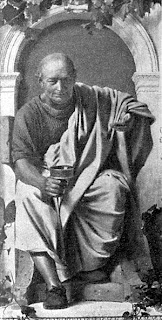
Quintus Horatius Flaccus revisited

Several weeks ago I was straightening up some of my older books (i.e. trying to figure out what I had) and came across my highschool text of Latin poetry: selections from Catullus, Vergil, Horace, and some Martial. I also looked up my Penguin Classic translation of Horace, since my Latin is more rust than iron, to rediscover what I found so fascinating about him.
Horace, after fighting with the losing armies of Brutus after Caesar's murder, ended up becoming almost the unofficial poet laureate to Augustus. Virgil introduced him to Maecenas, a friend of Augustus who became his patron; he had a position with the government if he wanted it. With all that time and financial support, all he needed was talent. He had that.

Let him explain what he did. He claims to have taken the old. staid and solemn Latin forms and rhythms and urged them into older but more elaborate Greek lyric stanzas. He also shunned as much as possible the solemn poetry praising battle and empire that Augustus asked for, praising instead the little things he knew and held dear. In that way he was a forerunner of modern populist poets.

So. Instead of armies marching to war he wrote about country life, village and farm. Instead of triumphant generals celebrating victory, friends and acquaintances having a few drinks, joking around, talking about girls. Such a welcome change from Vergil's solemn Aeneid. With irony and self-deprecation he kept his personal life out of the poems. Rather than beg for emotional response, he presented the image; he was the first to claim that a poem must make the hearer "see" what the poet had in mind, the image of the imagination.


After two millenia, Horace still speaks with a voice that resonates today. His images captivate; his forms and metrics intrigue. Now to search for that Epistle, his "Ars Poetica."

Tuesday, March 10, 2009

Meaning and Poetry (3)

We've looked at different ways poetry can carry meaning. There is the apparent meaning which is conveyed by the words and images used. Delving a little deeper, we could find meaning in the connotations those words carried or the emotional references attached to them. Then, of course, there would be obscure or esoteric meanings, some that may not have been meant by the author. But underneath it all, a good poem can impart meaning by its structure.
By this I don't refer to such obvious devices as a Christmas poem in the shape of a bell, or any poem in any external concrete form. Let's look at the formats that have stood the test of time and are still in use. The sonnet is a solemn form, used to explore emotional themes and conclusions. Heroic couplets in which each two lines rhyme seem usefull to teach or preach. You could never do that with the quick, laughing form of the limerick nor with the dance-like repetition of the villanelle. Can you imagine Robert Services ballads in any other form? The line length and rhythm make an excellent conveyance for his tales. They would not lend themselves to express the solemnity found in a sonnet, nor the wit and dash of a limerick. Each form provides a well understood basis for its expression.
What happens too often in so-called free verse is that beneath all the words and images there is no trace of any structure. A poet who begins from structure and language and poetic devices will have so much more at hand to impart his meaning: literal, symbolic, emotional, or hidden. Certainly there is no rule that structure should be evident but a poem that holds together the way such forms tend to hold them will be that much stronger in its impact.
Even though you cannot immediately see the structure underlying a poem, you should be able to feel it. It is the backbone, the strength of a good poem. Structure carries meaning and also makes the poem memorable.

Friday, February 20, 2009

Form: the "Bones" of poetry

Listening to Laurie Miller's presentation on George Herbert gave me cause to think about form and shape in modern poetry, poetry that is so singly attached to "free verse." Herbert made use of form and shape in his poetry to enhance it, to create another layer of meaning. I often think that multiple layers of meaning, something that makes you go back to a poem again and again, is evident only in the more uncommon poems I come across.

Be asured I'm not talking about concrete poetry. If you want to format your poem about an infant in the shape of a baby's stroller, that's one thing. That just assumes the ignorance of the reader("See, this is what I'm talking about.") and makes no difference to the hearer. What I'm talking about is the basis of good poetry, its rhythm and its sound.
Rhythm and sound come down to two pertinent and important poetic tools: meter and rhyme. The simplest and purest form of this is the heroic couplet, two lines of iambic pentameter that rhyme perfectly. It's the first thing a budding writer of rhyme tries for. It is one seldom achieved and mastered. How often have you read a line and known the rhyme ending the following line long before you reach it? Even then it is often either trite or forced, and leaves you with tasteless doggerel.

Good poems depend on good patterns of rhythm, not in a boring strictness. Good poems depend on a pattern of sound (in the ear or in the mind) not on simple "sounds like" line endings. Free verse, free from the age-old traditions, needs to be the result of two things: the poet's mastery of form in all its classical presentation and his ability to carry pattern and sound beyond that captured by such forms, not away from it.


Two old adages come to mind. First, to achieve freedom, you must first know your bonds. And second, it is better to make a small step forward than to slide a long way off the trail.