Wednesday, August 25, 2010

Expanding Experience

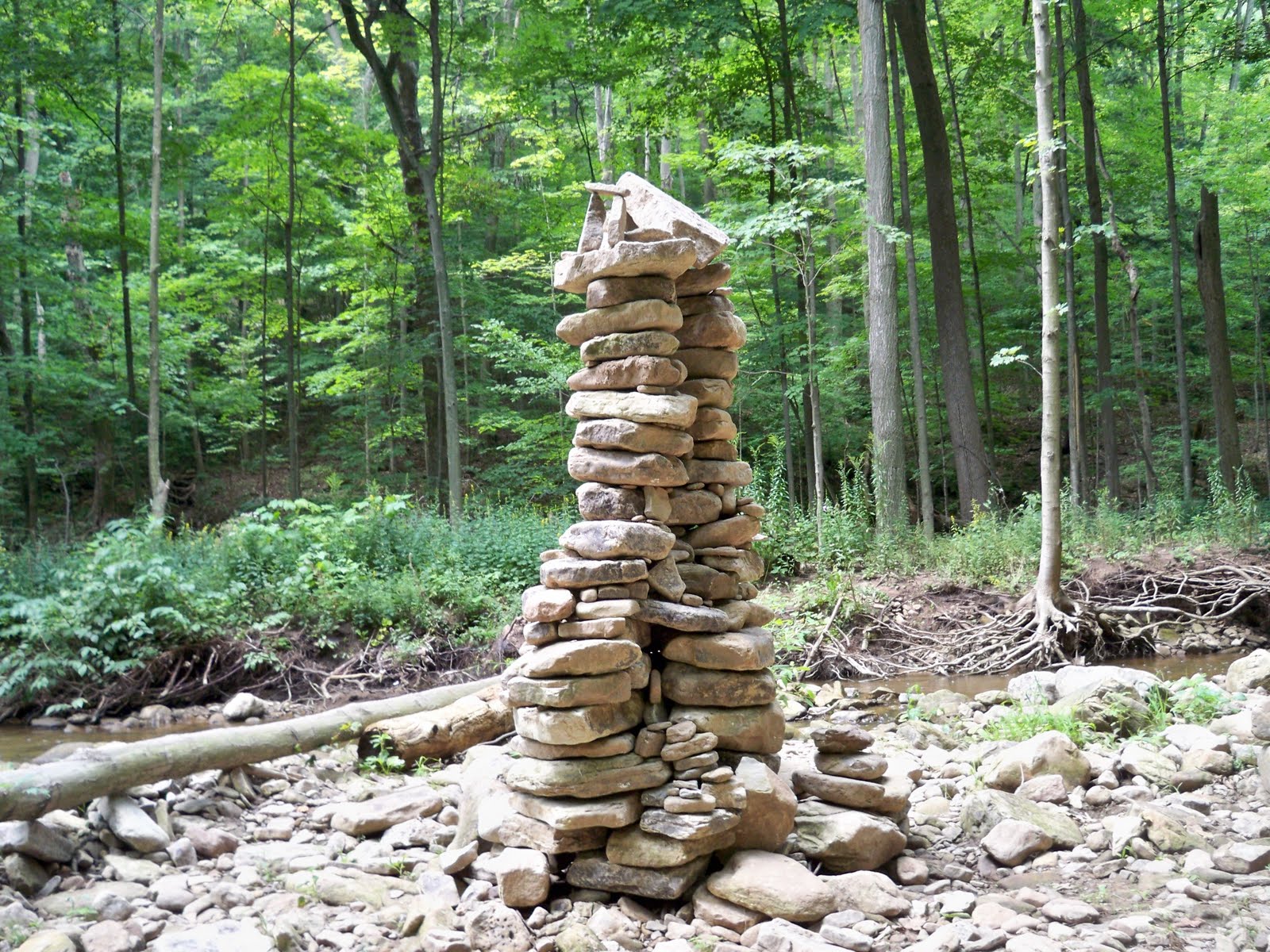
One of the things I do when I write a poem is to take a small image, something that impresses, that catches my attention with the emotional response it calls forth, and expand on it. Not always. Often the image that touches my perception can stand on its own and becomes a haiku. If it elicits one specific response, it will often become a tanka. But for a more expansive poem, the initial experience becomes the beginning of something else, something greater. Building a poem becomes an act reminiscent of constructing a cairn.

It’s not that the first impression has little or no intrinsic value. What happens is that I make connections to other events and emotions, and feel the need to bring them together. Often the first attempts will sound and feel over-sentimental, like a juvenile diary entry. Like building a cairn, shaping a poem takes time and effort.

Let me illustrate with an example – no, not the finished poem itself, but the layer-by-layer construction of it.
Sometime ago I was driving through wooded farmland on one of the four-lane divided highways toward sundown when I spotted some deer drinking from a creek several hundred meters away. Several factors impressed that sight in my mind: the evening light, the distance, the contrast of the natural (creek, deer, woods) and the constructed (highway, automobile, rushing humans), as well as my inability to stop and become a small part of that scene even though I wanted to do so.

Over the next few days that image would not leave me. It became connected to several other things. I was reminded of the creek on the farm where I grew up. I remembered also seeing and tracking deer in that area when I was young. The flowing water reminded me of a young lady I knew who loved to walk beside flowing water and stop to sit with her feet in the flowing water as a way to relax.

All these items came together in one unit, like different shaped stones in a cairn. Had the young lady, while sitting with feet in the running water of a creek, ever been surprised by deer coming to drink? She would be careful not to disturb them. Would she envy their freedom? I remembered that she now lived in a small city, married to a long-distance trucker. I wondered at the emotion she would feel, left alone so long so often. Would she go looking for flowing water to soothe her spirit? Would she remember the deer (the ones only my imagination provided)? Would she wonder if the deer remembered her?
So you see how the glimpse of deer drinking at sundown becomes a totally different thing, with the initial image remaining as a corner stone for the whole construct. My own emotional reactions, even my rational reaction, play only a secondary role to the imagined emotions of a young lady who is not part of the original.

And all that, as poetry, is as valid and real as deer beside a creek beside a highway.

Tuesday, August 17, 2010

Language Irritation

I just want to complain about a strange construction I have been finding in works published in the English language. For a long time I have heard it in the spoken language but have not, until recently, discovered it in a newspaper as well as a novel from a very respected publisher. Here it is:

One of the functions of the infinitive mood of a verb is as a noun. The infinitive is expressed with the preposition "to," as in "to find," "to make," "to have." Why, when an infinitive is a noun serving as object to a verb, should it be changed to a correlating verb connected by the coordinating conjunction "and"? Do you understand? Allow me to try to explain.

That construction is correct, but so many will say "try and explain." Even tense doesn't matter. Instead of saying " She came to see me yesterday" the tenseless infinitive takes on the relative preterite as "She came and saw me yesterday."

The examples could go on and on. The recent construction probably grew out of speakers' laziness; it is so much easier to say "and" instead of "to" especially when it can be slurred to " 'n' ."

So. Should we live with it or try and do something about it?


Saturday, August 14, 2010

Celebrating with the Word

Usually in present North American culture, we celebrate events and times by music and motion — song and dance. A wedding celebration naturally culminates in a dance; funerals and memorial services move from song to hymn. It was different then, and quite uplifting, to attend a literary event of celebration. Last night, as part of commemorating 175 years of existence in Hamilton, Stewart Memorial Church began their homecoming weekend with a gala of presentations of a literary nature.

The church was founded as part of the African Methodist Episcopal denomination and remains a predominantly Black congregation. Perhaps because of the ties to African slaves as well as more recent Caribbean migrations, this celebration by word was offered to the congregation and the public. Whatever the reasoning behind it, the concept worked.

It worked for several reasons. The writing presented was a mixture of both substance and style. There were presentations, authors reading excerpts from their books, that were historical and accurately researched; there were poets spinning words and images only grounded in experience; there were storytellers who took the factual to build stories that tugged at the spiritual and emotional parts of us. But the most notable aspect of the church’s literary evening of celebration was that it did not focus on the church, its history, its well-known members past and present. Instead it presented the culture of all the peoples it encompasses.

Nor did the words of celebration only recall the past. The past was dealt with in story and history; too, there were poems and stories of the present. From the poetry especially, joy and hope for the imagination. Commemoration of yesterday, the solidarity of today, the brightness of tomorrow: all were interwoven into the celebration. And rightly so.

Today the celebration continues, this time with music and song. Tomorrow a more solemn service with a guest preacher.

And it began with the words. Sound familiar? “In the beginning was the Word … ” (John 1:1)


Tuesday, August 10, 2010

Attitude Poetry

There’s a fellow poet with whom I was discussing the basics of poetry not long ago; on some things we agree but on others we don’t. That, I suppose, is to be expected.

We both agree that language is basic but each has a different emphasis on the way it should be used. I prefer to keep my words and expressions working the way they usually do. Nouns name things, verbs are action; adjectives describe nouns, adverbs explain action. They fit together in phrases and clauses. My friend will often turn a noun into a movement or a verb into a thing. That’s not new; we “squirrel” things away; a wave is an action or a thing. He just likes to do the same with words we don’t think of using in such a way.

He claims it helps establish “attitude.” Attitude, he says, is the second most important principle of poetry. Here we disagree. Rather than something as tenuous as attitude, I prefer to emphasize the tools used to make poetry —similes, metaphors, images, sound, rhythm, and shape — something he puts much lower on the list. So I began to consider attitude as an integral part of poetry.


Several instances that seemed important crossed my mind.
One occurred when someone read one of my poems before a group; he read it as words on the page, without the expression I would have given the delivery, without my “attitude,” if I could consider it like that. The second, strangely enough, was Cassius Clay/Muhammad Ali with his ‘poems’ not only predicting the outcome of his fights but also the descriptive “Float like a butterfly, sting like a bee,” phrasings that were new to the prizefighting game. Ali had attitude, physical and verbal. His words, his poetry, caught the ear and demanded attention.


I’m quite sure that this was what my friend meant by claiming poetry must have attitude. If a poem doesn’t grab and shake its hearers, it might pass away as if it had never been. And in a way this is also a valid point, this emphasis on attitude.

Jamaican-born Dub poetry grew out of this sensibility. Dub doesn’t live by the written word; its vitality lies in its performance. I grant that the tools of poetic language (rhyme, rhythm, etc.) are a vital part, but its attitude is most recognizable. Similarly today’s slam poetry with its aggressive and competitive aspects depends on attitude more than on well-formulated thought progression.

The question of attitude remains for me a matter of balance. Certainly a poem needs something special to make it stand apart from the common flow of words in our lives. However this expressiveness, this attitude, can become a cover hiding flaws, a thick coat of paint over the incipient rot in the wood.

After consideration this emphasis on “attitude” my friend espoused has moved up somewhat in my view of poetry and poetics. But care must be taken. It is too easy to push too hard, to blow too loud, and defeat the whole purpose of the attitude.


Thursday, August 5, 2010

Poet-Songwriter


Recently an acquaintance of mine published a collection of poetry. Now that’s not noteworthy; I know many writers, and usually somebody is bringing out a book. This person I know mainly as a musician who plays several instruments. I also understand that he was the main songwriter for a folk group some years ago. So we have a reputable musician and songwriter turning his talents to poetry.

Although there are great differences between writing songs and writing a poem, (I know, I’ve tried writing songs. I’ve even attended several workshops by excellent singer/songwriters) it’s not a great leap. Scotland’s Robbie Burns wrote lyric/poems. Some of the old folk ballads are wonderful poems apart from the tunes. So I had some expectations.

Granted, I did not expect a modern Burns. I did not look for comparisons to Leonard Cohen, Bob Dylan, or so many others. But I was certainly looking forward to see what this musician could do with words. And I’m sorry to say all my expectations went for naught. The “poems” in his book were … well I can’t really sum them up in a word or two although “drivel” comes close.

From a musician, I expect music. Since as a songwriter he must be aware of fitting words to rhythms, I looked for sustained rhythms and the use of sound because these are also basic components of poetry. Even the ancient Greeks saw music and poetry as a complimentary pair, as sister Muses.

I was sad to discover his poems do not sing. There is no hint of music, either obvious or latent. When I heard him read some to an audience it sounded like prose, and I thought I was missing something, something obscured by his delivery perhaps. When I examined his book in private, I found that was all there was: prosodic language masquerading (and not very well) as poetry. No marvelous use of language; none of the devices that make a poem the special thing it is. Lacking in imagery, lacking in descriptive phrasing, lacking the rhyme and assonance that connect poetry to music.

The poems about places read even less exciting than a travelogue. The poems about emotions read like a teenager’s diary. Most of the language didn’t rise above a hastily scribbled letter home.

And this is a singer, a songwriter, a musician. And now an artless arranger of meaningless prose. Words without music.

Who dare call it poetry?


Wednesday, July 28, 2010

Poetry and Multiculturalism


Yesterday I learned about an interesting poetry related event happening in Bologna, Italy earlier this month. Let me explain the event as I understand it, with cycling and recitation becoming a traveling presentation of poetry to the unwary as part of a multicultural festival. This is known as the “poeciclettata,” or “poetandem” as the English language media expresses it.

A number of poets are recruited to recite from memory a poem in a language foreign to Italy, not the poet, a language native to a segment of the population of the region. These dozen or so gather in a suburban square and recite their poems at different locations in the square to passersby and anyone who cares to gather. Poets are usually accompanied by hand drummers (acting first as a call to attention and then as a background rhythm.) After the performances are done, the poets and drummers (in tandem?) take off on their bicycles for the next stop, ready to invade another public square and repeat their performances. It takes place in late afternoon and early evening, ending with a public party after the final performance.

I love the idea! I can see it now: the drumming gathers a few people, the poet begins to recite. The words mean nothing to some or most of the audience, but one or two are excited – hey, that’s my native language! Maybe they pull out a cell phone, spread the news. Others recognize their own language from other poets who are performing nearby. The poets repeat at intervals; it’s not a personal reading. After a set time all of them, poets, drummers, and possibly some of the audience, take off for the next public space to repeat. As they move on, the cyclist audience travels with them and the whole thing just grows!

Bringing poetry back to the people, not just to native speakers but to migrants who have settled or are passing through. In a way it’s like Canada’s “Random Acts of Poetry” but with an ecology minded emphasis (bicycles) and a lot of street theatre thrown in.


And then I imagine it happening here. Poetry for the people entering or leaving the mall. In Korean, Urdu, Arabic, Spanish. Moving on by bicycle to the bus station, the train station. Stopping by the city’s ethnic neighborhoods. Ending with music and food in a downtown park.

Yes! Poetry as an expression of culture. Poetry as fun and pleasure. Poetry as a reason to party. Bring it on!

Monday, July 26, 2010

Multidiscipline Improvisation


It was not just another Saturday night at the ArtwordArtbar. This Saturday night was special. No musical act had been lined up and since the venue is inclined toward all the arts (and with the availability of some of the guests at this time) the proprietors decided to hold a multidiscipline improvisation evening.

They had done something of the sort before: dance, some music, video projection on a screen behind the dancer. This session was intended to be expanded. An artist who created and layered sound and music on his laptop computer was available and eager. A new projection program needed to be tried in a more public situation. Several dancers and various musicians were ready to take part. And to this mix I suggested myself.

What I wanted to do was something I had tried before, a good number of years before. I wanted to place some of my poetry before an audience ― with enhancements not of my own making. Back in the eighties I had come together with a saxophonist and a male dancer; we had begun work on a suite combining words – music – movement to explore a primitive understanding of the world. Although the concept was never fully fleshed out for anything like public presentation, the urge to see my work interpreted by other artists has always remained in the back of my mind. Here, I believed, was the chance to do something similar. I would speak my words. My voice would stand alone without my usual stage presence and physical movement. Instead the flow of words would be interpreted instantly and without prior consultation by a dancer or dancers there on the stage.

My idea was welcomed. I would present two poems, one in each set, and then be obligated to take part in a free, unstructured performance of all the artists involved.

I decided that the first poem would be just myself and the dancers, three ladies. I wanted to recite from off stage but they preferred me onstage as they moved around me. I compromised, sitting on the front of the stage with my words and microphone, presenting the poem as they moved and controlled the open space before me while the projectionist worked her magic on the screen behind us. At the break between sets we discussed the presentation. My difficulty had been that I was not able to see their movement and use that to vary the pacing and tone; one of the dancers expressed a slight frustration that sometimes my presentation didn’t match what she expected from the words. All valid and useful comments.


My second presentation was not as concrete in imagery, leaving it more open to interpretation. I also asked the musicians ― bass, percussion, violin, and the aforementioned computer keyboardist ― to come in wherever they felt they could. This time, I stayed off-stage and was able to watch the dancers, vary the pace and intonation; the musicians were doing the same. This ensemble seemed to work together well, not flawlessly but to the satisfaction of the whole group.

Then, to end the evening after another break for refreshing mind and body, the improvisational “free-for-all.” The focus of this extensive … I suppose you could call it a “jam” … was the dancers on stage: as individuals, in twos, as a trio. To their actions each of the other artist/participants added their own layer, using their own medium. As a poet, I am not able to compose and speak out on the spot but I did not withdraw from the fusion. I used the opportunity to add voiced sounds ― sometimes words, phrases, short sentences, but more often hums or unstructured voice. I would take a clear vowel and slowly run it through different shapes of the mouth or flit it back and forth. Throw in a few do-wop phrasings (often at greatly reduced rhythms) and I knew I was contributing to the whole, even wordlessly.

Ah, the magic! Layers of creative expression, unrehearsed and spontaneous.
I look forward to the next time I can be part of such an experience.